Benchmarks
The usual starting point is MATLAB at low resolution: it keeps the model easy to inspect while you build physical understanding and establish that the configuration behaves as intended. Once the science is clear, higher resolutions, different integrators, or compiled execution may be useful. This page summarizes measured runtime and memory tradeoffs to help decide when that added complexity is worthwhile.
MATLAB vs C++
Setup. The primary release campaign uses RK78 for a 150 km × 150 km × 1.3 km domain, initialized with GM(0.5) waves and a first-baroclinic red geostrophic spectrum, for 7168 s. It uses a 256 × 256 × 129 grid. Select constant nonhydrostatic, Hydrostatic exponential, or Boussinesq exponential to view the corresponding measured model configuration; an unavailable panel means that model has not been measured in the selected campaign.
Conclusion. Read the winner labels and ratios within the selected release campaign. They describe the recorded source and environment for that campaign.
Constant nonhydrostatic
Release 4.4.1 · Apple M4 Max · collected 2026-09-14
Median integration time and peak process memory from three fresh runs; startup and preparation are excluded.
| Workload | Interface | Runtime | Speedup vs MATLAB | Peak memory |
|---|---|---|---|---|
| Coefficients only | MATLAB builtin | 36.93 s | 1.00× baseline | 4.18 GiB |
| MATLAB + compiled core | 15.67 s | 2.36× | 5.88 GiB | |
| Standalone C++ | 13.02 sFastest | 2.84× | 1.86 GiBLowest memory | |
| Composite dense output | MATLAB builtin | 52.89 s | 1.00× baseline | 10.2 GiB |
| MATLAB + compiled core | 42.4 s | 1.25× | 12.5 GiB | |
| Standalone C++ | 20.78 sFastest | 2.54× | 3.52 GiBLowest memory |
Record provenance
Dataset three-interface--constant-nonhydrostatic--m4-max--20260914T002703Z; source commit c08b70471099682b5dc5d30c7ed0993b5c697c42; provider native-neon-pthreads 3.3.11; 3 fresh processes; MATLAB 25.2.0.3150157 (R2025b) Update 4; configured thread budget 16.
Compiled execution policy: matlab-compiled: non-variable-transform; FFT threads 16; budget 16; standalone-compiled: non-variable-transform; FFT threads 16; budget 16
Observed integration-time ranges: coefficient-endpoint / matlab-builtin: 35.22–37.78 s; coefficient-endpoint / matlab-compiled: 15.57–15.89 s; coefficient-endpoint / standalone-compiled: 12.81–13.32 s; composite-dense-output / matlab-builtin: 52.87–53.17 s; composite-dense-output / matlab-compiled: 42.3–42.58 s; composite-dense-output / standalone-compiled: 20.37–21.14 s
Hydrostatic exponential
Release 4.4.1 · Apple M4 Max · collected 2026-09-13
Median integration time and peak process memory from three fresh runs; startup and preparation are excluded.
| Workload | Interface | Runtime | Speedup vs MATLAB | Peak memory |
|---|---|---|---|---|
| Coefficients only | MATLAB builtin | 36.58 s | 1.00× baseline | 4.03 GiB |
| MATLAB + compiled core | 13.11 s | 2.79× | 6.21 GiB | |
| Standalone C++ | 10.38 sFastest | 3.52× | 2.37 GiBLowest memory | |
| Composite dense output | MATLAB builtin | 55.43 s | 1.00× baseline | 10 GiB |
| MATLAB + compiled core | 33.9 s | 1.64× | 12.9 GiB | |
| Standalone C++ | 17.17 sFastest | 3.23× | 3.88 GiBLowest memory |
Record provenance
Dataset three-interface--hydrostatic-exponential--m4-max--20260913T234347Z; source commit c08b70471099682b5dc5d30c7ed0993b5c697c42; provider native-neon-pthreads 3.3.11; 3 fresh processes; MATLAB 25.2.0.3150157 (R2025b) Update 4; configured thread budget 16.
Compiled execution policy: matlab-compiled: compact-native-accelerate; FFT threads 1; budget 16; horizontal workers 12; pointwise workers 8; standalone-compiled: compact-native-accelerate; FFT threads 1; budget 16; horizontal workers 12; pointwise workers 8
Observed integration-time ranges: coefficient-endpoint / matlab-builtin: 36.35–36.83 s; coefficient-endpoint / matlab-compiled: 13.09–13.13 s; coefficient-endpoint / standalone-compiled: 10.31–10.53 s; composite-dense-output / matlab-builtin: 55.13–55.54 s; composite-dense-output / matlab-compiled: 33.77–33.98 s; composite-dense-output / standalone-compiled: 17.12–17.23 s
Boussinesq exponential
Release 4.4.1 · Apple M4 Max · collected 2026-09-13
Median integration time and peak process memory from three fresh runs; startup and preparation are excluded.
| Workload | Interface | Runtime | Speedup vs MATLAB | Peak memory |
|---|---|---|---|---|
| Coefficients only | MATLAB builtin | 70.67 s | 1.00× baseline | 5.09 GiBLowest memory |
| MATLAB + compiled core | 16.02 s | 4.41× | 9.97 GiB | |
| Standalone C++ | 13.83 sFastest | 5.11× | 6.14 GiB | |
| Composite dense output | MATLAB builtin | 87.01 s | 1.00× baseline | 11.1 GiB |
| MATLAB + compiled core | 33.32 s | 2.61× | 16.9 GiB | |
| Standalone C++ | 19.31 sFastest | 4.51× | 7.65 GiBLowest memory |
Record provenance
Dataset three-interface--boussinesq-exponential--m4-max--20260913T235744Z; source commit c08b70471099682b5dc5d30c7ed0993b5c697c42; provider native-neon-pthreads 3.3.11; 3 fresh processes; MATLAB 25.2.0.3150157 (R2025b) Update 4; configured thread budget 16.
Compiled execution policy: matlab-compiled: compact-native-accelerate; FFT threads 1; budget 16; horizontal workers 12; pointwise workers 8; standalone-compiled: compact-native-accelerate; FFT threads 1; budget 16; horizontal workers 12; pointwise workers 8
Observed integration-time ranges: coefficient-endpoint / matlab-builtin: 70.47–70.87 s; coefficient-endpoint / matlab-compiled: 15.99–16.04 s; coefficient-endpoint / standalone-compiled: 13.77–13.97 s; composite-dense-output / matlab-builtin: 86.78–87.07 s; composite-dense-output / matlab-compiled: 33.3–33.54 s; composite-dense-output / standalone-compiled: 19.18–19.6 s
MATLAB speed scaling
Setup. These historical tests evaluate one state-advanced nonlinearFlux call using MATLAB’s builtin transforms with anti-aliasing enabled. The representative plots use a constant-stratification, nonhydrostatic model in a 15 km × 15 km × 1.3 km domain. Horizontal sweeps vary Nx = Ny, holding Nz = 65 in the standard suite and Nz = 129 in the large suite; vertical sweeps vary Nz, holding Nx = Ny at 128 or 512. The model, transform, and operation are otherwise fixed. Each expanded table identifies the recorded WaveVortexModel version, MATLAB release, platform, and suite.
Conclusion. Within these MATLAB builtin records, horizontal refinement is the stronger runtime constraint: at large resolutions, doubling both horizontal dimensions increases runtime by roughly fourfold, while doubling the vertical resolution increases it by about two to two-and-a-half times. The scaling plots do not measure the current compiled C++ runtime.
Runtime versus horizontal resolution
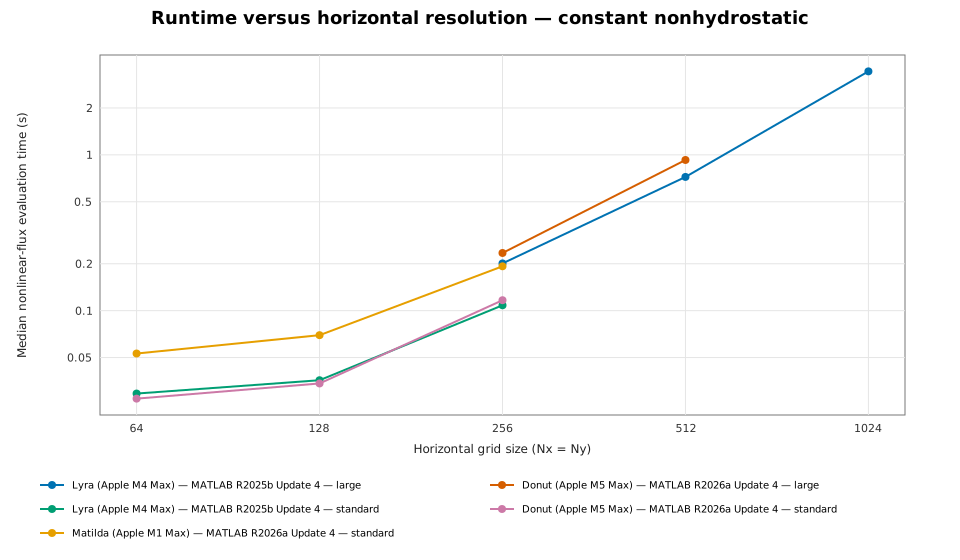
View all benchmark data
| Suite | Transform | Dataset | Resolution | Value | Status | Reason |
|---|---|---|---|---|---|---|
| scaling-large-v1 | Barotropic QG | Donut (Apple M5 Max) — WaveVortexModel MATLAB 4.2.1 (builtin; MATLAB 26.1.0.3312084 (R2026a) Update 4) — scaling-large-v1 | 2048 | 0.03453 s | complete | — |
| scaling-large-v1 | Barotropic QG | Lyra (Apple M4 Max) — WaveVortexModel MATLAB 4.2.1 (builtin; MATLAB 25.2.0.3150157 (R2025b) Update 4) — scaling-large-v1 | 2048 | 0.03972 s | complete | — |
| scaling-large-v1 | Barotropic QG | Matilda (Apple M1 Max) — WaveVortexModel MATLAB 4.2.1 (builtin; MATLAB 26.1.0.3312084 (R2026a) Update 4) — scaling-large-v1 | 2048 | Unavailable | unavailable | No scaling-large-v1 dataset was collected for this environment. |
| scaling-large-v1 | Barotropic QG | Donut (Apple M5 Max) — WaveVortexModel MATLAB 4.2.1 (builtin; MATLAB 26.1.0.3312084 (R2026a) Update 4) — scaling-large-v1 | 4096 | 0.124 s | complete | — |
| scaling-large-v1 | Barotropic QG | Lyra (Apple M4 Max) — WaveVortexModel MATLAB 4.2.1 (builtin; MATLAB 25.2.0.3150157 (R2025b) Update 4) — scaling-large-v1 | 4096 | 0.1439 s | complete | — |
| scaling-large-v1 | Barotropic QG | Matilda (Apple M1 Max) — WaveVortexModel MATLAB 4.2.1 (builtin; MATLAB 26.1.0.3312084 (R2026a) Update 4) — scaling-large-v1 | 4096 | Unavailable | unavailable | No scaling-large-v1 dataset was collected for this environment. |
| scaling-large-v1 | Constant hydrostatic | Donut (Apple M5 Max) — WaveVortexModel MATLAB 4.2.1 (builtin; MATLAB 26.1.0.3312084 (R2026a) Update 4) — scaling-large-v1 | 1024 | Unavailable | unavailable | Not collected on this 48 GiB host because the observed memory requirement left insufficient safety margin. |
| scaling-large-v1 | Constant hydrostatic | Lyra (Apple M4 Max) — WaveVortexModel MATLAB 4.2.1 (builtin; MATLAB 25.2.0.3150157 (R2025b) Update 4) — scaling-large-v1 | 1024 | 2.854 s | complete | — |
| scaling-large-v1 | Constant hydrostatic | Matilda (Apple M1 Max) — WaveVortexModel MATLAB 4.2.1 (builtin; MATLAB 26.1.0.3312084 (R2026a) Update 4) — scaling-large-v1 | 1024 | Unavailable | unavailable | No scaling-large-v1 dataset was collected for this environment. |
| scaling-large-v1 | Constant hydrostatic | Donut (Apple M5 Max) — WaveVortexModel MATLAB 4.2.1 (builtin; MATLAB 26.1.0.3312084 (R2026a) Update 4) — scaling-large-v1 | 256 | 0.1856 s | complete | — |
| scaling-large-v1 | Constant hydrostatic | Lyra (Apple M4 Max) — WaveVortexModel MATLAB 4.2.1 (builtin; MATLAB 25.2.0.3150157 (R2025b) Update 4) — scaling-large-v1 | 256 | 0.1763 s | complete | — |
| scaling-large-v1 | Constant hydrostatic | Matilda (Apple M1 Max) — WaveVortexModel MATLAB 4.2.1 (builtin; MATLAB 26.1.0.3312084 (R2026a) Update 4) — scaling-large-v1 | 256 | Unavailable | unavailable | No scaling-large-v1 dataset was collected for this environment. |
| scaling-large-v1 | Constant hydrostatic | Donut (Apple M5 Max) — WaveVortexModel MATLAB 4.2.1 (builtin; MATLAB 26.1.0.3312084 (R2026a) Update 4) — scaling-large-v1 | 512 | 0.816 s | complete | — |
| scaling-large-v1 | Constant hydrostatic | Lyra (Apple M4 Max) — WaveVortexModel MATLAB 4.2.1 (builtin; MATLAB 25.2.0.3150157 (R2025b) Update 4) — scaling-large-v1 | 512 | 0.6859 s | complete | — |
| scaling-large-v1 | Constant hydrostatic | Matilda (Apple M1 Max) — WaveVortexModel MATLAB 4.2.1 (builtin; MATLAB 26.1.0.3312084 (R2026a) Update 4) — scaling-large-v1 | 512 | Unavailable | unavailable | No scaling-large-v1 dataset was collected for this environment. |
| scaling-large-v1 | Constant nonhydrostatic | Donut (Apple M5 Max) — WaveVortexModel MATLAB 4.2.1 (builtin; MATLAB 26.1.0.3312084 (R2026a) Update 4) — scaling-large-v1 | 1024 | Unavailable | unavailable | Not collected on this 48 GiB host because the observed memory requirement left insufficient safety margin. |
| scaling-large-v1 | Constant nonhydrostatic | Lyra (Apple M4 Max) — WaveVortexModel MATLAB 4.2.1 (builtin; MATLAB 25.2.0.3150157 (R2025b) Update 4) — scaling-large-v1 | 1024 | 3.435 s | complete | — |
| scaling-large-v1 | Constant nonhydrostatic | Matilda (Apple M1 Max) — WaveVortexModel MATLAB 4.2.1 (builtin; MATLAB 26.1.0.3312084 (R2026a) Update 4) — scaling-large-v1 | 1024 | Unavailable | unavailable | No scaling-large-v1 dataset was collected for this environment. |
| scaling-large-v1 | Constant nonhydrostatic | Donut (Apple M5 Max) — WaveVortexModel MATLAB 4.2.1 (builtin; MATLAB 26.1.0.3312084 (R2026a) Update 4) — scaling-large-v1 | 256 | 0.2345 s | complete | — |
| scaling-large-v1 | Constant nonhydrostatic | Lyra (Apple M4 Max) — WaveVortexModel MATLAB 4.2.1 (builtin; MATLAB 25.2.0.3150157 (R2025b) Update 4) — scaling-large-v1 | 256 | 0.201 s | complete | — |
| scaling-large-v1 | Constant nonhydrostatic | Matilda (Apple M1 Max) — WaveVortexModel MATLAB 4.2.1 (builtin; MATLAB 26.1.0.3312084 (R2026a) Update 4) — scaling-large-v1 | 256 | Unavailable | unavailable | No scaling-large-v1 dataset was collected for this environment. |
| scaling-large-v1 | Constant nonhydrostatic | Donut (Apple M5 Max) — WaveVortexModel MATLAB 4.2.1 (builtin; MATLAB 26.1.0.3312084 (R2026a) Update 4) — scaling-large-v1 | 512 | 0.9271 s | complete | — |
| scaling-large-v1 | Constant nonhydrostatic | Lyra (Apple M4 Max) — WaveVortexModel MATLAB 4.2.1 (builtin; MATLAB 25.2.0.3150157 (R2025b) Update 4) — scaling-large-v1 | 512 | 0.7217 s | complete | — |
| scaling-large-v1 | Constant nonhydrostatic | Matilda (Apple M1 Max) — WaveVortexModel MATLAB 4.2.1 (builtin; MATLAB 26.1.0.3312084 (R2026a) Update 4) — scaling-large-v1 | 512 | Unavailable | unavailable | No scaling-large-v1 dataset was collected for this environment. |
| scaling-large-v1 | Stratified QG | Donut (Apple M5 Max) — WaveVortexModel MATLAB 4.2.1 (builtin; MATLAB 26.1.0.3312084 (R2026a) Update 4) — scaling-large-v1 | 256 | 0.05811 s | complete | — |
| scaling-large-v1 | Stratified QG | Lyra (Apple M4 Max) — WaveVortexModel MATLAB 4.2.1 (builtin; MATLAB 25.2.0.3150157 (R2025b) Update 4) — scaling-large-v1 | 256 | 0.0614 s | complete | — |
| scaling-large-v1 | Stratified QG | Matilda (Apple M1 Max) — WaveVortexModel MATLAB 4.2.1 (builtin; MATLAB 26.1.0.3312084 (R2026a) Update 4) — scaling-large-v1 | 256 | Unavailable | unavailable | No scaling-large-v1 dataset was collected for this environment. |
| scaling-large-v1 | Stratified QG | Donut (Apple M5 Max) — WaveVortexModel MATLAB 4.2.1 (builtin; MATLAB 26.1.0.3312084 (R2026a) Update 4) — scaling-large-v1 | 512 | 0.248 s | complete | — |
| scaling-large-v1 | Stratified QG | Lyra (Apple M4 Max) — WaveVortexModel MATLAB 4.2.1 (builtin; MATLAB 25.2.0.3150157 (R2025b) Update 4) — scaling-large-v1 | 512 | 0.2291 s | complete | — |
| scaling-large-v1 | Stratified QG | Matilda (Apple M1 Max) — WaveVortexModel MATLAB 4.2.1 (builtin; MATLAB 26.1.0.3312084 (R2026a) Update 4) — scaling-large-v1 | 512 | Unavailable | unavailable | No scaling-large-v1 dataset was collected for this environment. |
| scaling-large-v1 | Variable Boussinesq | Donut (Apple M5 Max) — WaveVortexModel MATLAB 4.2.1 (builtin; MATLAB 26.1.0.3312084 (R2026a) Update 4) — scaling-large-v1 | 256 | 0.4014 s | complete | — |
| scaling-large-v1 | Variable Boussinesq | Lyra (Apple M4 Max) — WaveVortexModel MATLAB 4.2.1 (builtin; MATLAB 25.2.0.3150157 (R2025b) Update 4) — scaling-large-v1 | 256 | 0.4398 s | complete | — |
| scaling-large-v1 | Variable Boussinesq | Matilda (Apple M1 Max) — WaveVortexModel MATLAB 4.2.1 (builtin; MATLAB 26.1.0.3312084 (R2026a) Update 4) — scaling-large-v1 | 256 | Unavailable | unavailable | No scaling-large-v1 dataset was collected for this environment. |
| scaling-large-v1 | Variable Boussinesq | Donut (Apple M5 Max) — WaveVortexModel MATLAB 4.2.1 (builtin; MATLAB 26.1.0.3312084 (R2026a) Update 4) — scaling-large-v1 | 512 | 1.54 s | complete | — |
| scaling-large-v1 | Variable Boussinesq | Lyra (Apple M4 Max) — WaveVortexModel MATLAB 4.2.1 (builtin; MATLAB 25.2.0.3150157 (R2025b) Update 4) — scaling-large-v1 | 512 | 1.597 s | complete | — |
| scaling-large-v1 | Variable Boussinesq | Matilda (Apple M1 Max) — WaveVortexModel MATLAB 4.2.1 (builtin; MATLAB 26.1.0.3312084 (R2026a) Update 4) — scaling-large-v1 | 512 | Unavailable | unavailable | No scaling-large-v1 dataset was collected for this environment. |
| scaling-large-v1 | Variable hydrostatic | Donut (Apple M5 Max) — WaveVortexModel MATLAB 4.2.1 (builtin; MATLAB 26.1.0.3312084 (R2026a) Update 4) — scaling-large-v1 | 256 | 0.1738 s | complete | — |
| scaling-large-v1 | Variable hydrostatic | Lyra (Apple M4 Max) — WaveVortexModel MATLAB 4.2.1 (builtin; MATLAB 25.2.0.3150157 (R2025b) Update 4) — scaling-large-v1 | 256 | 0.1775 s | complete | — |
| scaling-large-v1 | Variable hydrostatic | Matilda (Apple M1 Max) — WaveVortexModel MATLAB 4.2.1 (builtin; MATLAB 26.1.0.3312084 (R2026a) Update 4) — scaling-large-v1 | 256 | Unavailable | unavailable | No scaling-large-v1 dataset was collected for this environment. |
| scaling-large-v1 | Variable hydrostatic | Donut (Apple M5 Max) — WaveVortexModel MATLAB 4.2.1 (builtin; MATLAB 26.1.0.3312084 (R2026a) Update 4) — scaling-large-v1 | 512 | 0.7167 s | complete | — |
| scaling-large-v1 | Variable hydrostatic | Lyra (Apple M4 Max) — WaveVortexModel MATLAB 4.2.1 (builtin; MATLAB 25.2.0.3150157 (R2025b) Update 4) — scaling-large-v1 | 512 | 0.66 s | complete | — |
| scaling-large-v1 | Variable hydrostatic | Matilda (Apple M1 Max) — WaveVortexModel MATLAB 4.2.1 (builtin; MATLAB 26.1.0.3312084 (R2026a) Update 4) — scaling-large-v1 | 512 | Unavailable | unavailable | No scaling-large-v1 dataset was collected for this environment. |
| scaling-standard-v1 | Barotropic QG | Donut (Apple M5 Max) — WaveVortexModel MATLAB 4.2.1 (builtin; MATLAB 26.1.0.3312084 (R2026a) Update 4) — scaling-standard-v1 | 1024 | 0.009262 s | complete | — |
| scaling-standard-v1 | Barotropic QG | Lyra (Apple M4 Max) — WaveVortexModel MATLAB 4.2.1 (builtin; MATLAB 25.2.0.3150157 (R2025b) Update 4) — scaling-standard-v1 | 1024 | 0.01047 s | complete | — |
| scaling-standard-v1 | Barotropic QG | Matilda (Apple M1 Max) — WaveVortexModel MATLAB 4.2.1 (builtin; MATLAB 26.1.0.3312084 (R2026a) Update 4) — scaling-standard-v1 | 1024 | 0.01742 s | complete | — |
| scaling-standard-v1 | Barotropic QG | Donut (Apple M5 Max) — WaveVortexModel MATLAB 4.2.1 (builtin; MATLAB 26.1.0.3312084 (R2026a) Update 4) — scaling-standard-v1 | 128 | 0.003954 s | complete | — |
| scaling-standard-v1 | Barotropic QG | Lyra (Apple M4 Max) — WaveVortexModel MATLAB 4.2.1 (builtin; MATLAB 25.2.0.3150157 (R2025b) Update 4) — scaling-standard-v1 | 128 | 0.006815 s | complete | — |
| scaling-standard-v1 | Barotropic QG | Matilda (Apple M1 Max) — WaveVortexModel MATLAB 4.2.1 (builtin; MATLAB 26.1.0.3312084 (R2026a) Update 4) — scaling-standard-v1 | 128 | 0.006729 s | complete | — |
| scaling-standard-v1 | Barotropic QG | Donut (Apple M5 Max) — WaveVortexModel MATLAB 4.2.1 (builtin; MATLAB 26.1.0.3312084 (R2026a) Update 4) — scaling-standard-v1 | 256 | 0.003074 s | complete | — |
| scaling-standard-v1 | Barotropic QG | Lyra (Apple M4 Max) — WaveVortexModel MATLAB 4.2.1 (builtin; MATLAB 25.2.0.3150157 (R2025b) Update 4) — scaling-standard-v1 | 256 | 0.003979 s | complete | — |
| scaling-standard-v1 | Barotropic QG | Matilda (Apple M1 Max) — WaveVortexModel MATLAB 4.2.1 (builtin; MATLAB 26.1.0.3312084 (R2026a) Update 4) — scaling-standard-v1 | 256 | 0.005184 s | complete | — |
| scaling-standard-v1 | Barotropic QG | Donut (Apple M5 Max) — WaveVortexModel MATLAB 4.2.1 (builtin; MATLAB 26.1.0.3312084 (R2026a) Update 4) — scaling-standard-v1 | 512 | 0.004114 s | complete | — |
| scaling-standard-v1 | Barotropic QG | Lyra (Apple M4 Max) — WaveVortexModel MATLAB 4.2.1 (builtin; MATLAB 25.2.0.3150157 (R2025b) Update 4) — scaling-standard-v1 | 512 | 0.004362 s | complete | — |
| scaling-standard-v1 | Barotropic QG | Matilda (Apple M1 Max) — WaveVortexModel MATLAB 4.2.1 (builtin; MATLAB 26.1.0.3312084 (R2026a) Update 4) — scaling-standard-v1 | 512 | 0.006939 s | complete | — |
| scaling-standard-v1 | Constant hydrostatic | Donut (Apple M5 Max) — WaveVortexModel MATLAB 4.2.1 (builtin; MATLAB 26.1.0.3312084 (R2026a) Update 4) — scaling-standard-v1 | 128 | 0.02826 s | complete | — |
| scaling-standard-v1 | Constant hydrostatic | Lyra (Apple M4 Max) — WaveVortexModel MATLAB 4.2.1 (builtin; MATLAB 25.2.0.3150157 (R2025b) Update 4) — scaling-standard-v1 | 128 | 0.02966 s | complete | — |
| scaling-standard-v1 | Constant hydrostatic | Matilda (Apple M1 Max) — WaveVortexModel MATLAB 4.2.1 (builtin; MATLAB 26.1.0.3312084 (R2026a) Update 4) — scaling-standard-v1 | 128 | 0.05619 s | complete | — |
| scaling-standard-v1 | Constant hydrostatic | Donut (Apple M5 Max) — WaveVortexModel MATLAB 4.2.1 (builtin; MATLAB 26.1.0.3312084 (R2026a) Update 4) — scaling-standard-v1 | 256 | 0.09103 s | complete | — |
| scaling-standard-v1 | Constant hydrostatic | Lyra (Apple M4 Max) — WaveVortexModel MATLAB 4.2.1 (builtin; MATLAB 25.2.0.3150157 (R2025b) Update 4) — scaling-standard-v1 | 256 | 0.0869 s | complete | — |
| scaling-standard-v1 | Constant hydrostatic | Matilda (Apple M1 Max) — WaveVortexModel MATLAB 4.2.1 (builtin; MATLAB 26.1.0.3312084 (R2026a) Update 4) — scaling-standard-v1 | 256 | 0.1598 s | complete | — |
| scaling-standard-v1 | Constant hydrostatic | Donut (Apple M5 Max) — WaveVortexModel MATLAB 4.2.1 (builtin; MATLAB 26.1.0.3312084 (R2026a) Update 4) — scaling-standard-v1 | 64 | 0.01337 s | complete | — |
| scaling-standard-v1 | Constant hydrostatic | Lyra (Apple M4 Max) — WaveVortexModel MATLAB 4.2.1 (builtin; MATLAB 25.2.0.3150157 (R2025b) Update 4) — scaling-standard-v1 | 64 | 0.01423 s | complete | — |
| scaling-standard-v1 | Constant hydrostatic | Matilda (Apple M1 Max) — WaveVortexModel MATLAB 4.2.1 (builtin; MATLAB 26.1.0.3312084 (R2026a) Update 4) — scaling-standard-v1 | 64 | 0.02684 s | complete | — |
| scaling-standard-v1 | Constant nonhydrostatic | Donut (Apple M5 Max) — WaveVortexModel MATLAB 4.2.1 (builtin; MATLAB 26.1.0.3312084 (R2026a) Update 4) — scaling-standard-v1 | 128 | 0.03409 s | complete | — |
| scaling-standard-v1 | Constant nonhydrostatic | Lyra (Apple M4 Max) — WaveVortexModel MATLAB 4.2.1 (builtin; MATLAB 25.2.0.3150157 (R2025b) Update 4) — scaling-standard-v1 | 128 | 0.03576 s | complete | — |
| scaling-standard-v1 | Constant nonhydrostatic | Matilda (Apple M1 Max) — WaveVortexModel MATLAB 4.2.1 (builtin; MATLAB 26.1.0.3312084 (R2026a) Update 4) — scaling-standard-v1 | 128 | 0.0696 s | complete | — |
| scaling-standard-v1 | Constant nonhydrostatic | Donut (Apple M5 Max) — WaveVortexModel MATLAB 4.2.1 (builtin; MATLAB 26.1.0.3312084 (R2026a) Update 4) — scaling-standard-v1 | 256 | 0.1167 s | complete | — |
| scaling-standard-v1 | Constant nonhydrostatic | Lyra (Apple M4 Max) — WaveVortexModel MATLAB 4.2.1 (builtin; MATLAB 25.2.0.3150157 (R2025b) Update 4) — scaling-standard-v1 | 256 | 0.1082 s | complete | — |
| scaling-standard-v1 | Constant nonhydrostatic | Matilda (Apple M1 Max) — WaveVortexModel MATLAB 4.2.1 (builtin; MATLAB 26.1.0.3312084 (R2026a) Update 4) — scaling-standard-v1 | 256 | 0.1926 s | complete | — |
| scaling-standard-v1 | Constant nonhydrostatic | Donut (Apple M5 Max) — WaveVortexModel MATLAB 4.2.1 (builtin; MATLAB 26.1.0.3312084 (R2026a) Update 4) — scaling-standard-v1 | 64 | 0.02724 s | complete | — |
| scaling-standard-v1 | Constant nonhydrostatic | Lyra (Apple M4 Max) — WaveVortexModel MATLAB 4.2.1 (builtin; MATLAB 25.2.0.3150157 (R2025b) Update 4) — scaling-standard-v1 | 64 | 0.02937 s | complete | — |
| scaling-standard-v1 | Constant nonhydrostatic | Matilda (Apple M1 Max) — WaveVortexModel MATLAB 4.2.1 (builtin; MATLAB 26.1.0.3312084 (R2026a) Update 4) — scaling-standard-v1 | 64 | 0.05307 s | complete | — |
| scaling-standard-v1 | Stratified QG | Donut (Apple M5 Max) — WaveVortexModel MATLAB 4.2.1 (builtin; MATLAB 26.1.0.3312084 (R2026a) Update 4) — scaling-standard-v1 | 128 | 0.009861 s | complete | — |
| scaling-standard-v1 | Stratified QG | Lyra (Apple M4 Max) — WaveVortexModel MATLAB 4.2.1 (builtin; MATLAB 25.2.0.3150157 (R2025b) Update 4) — scaling-standard-v1 | 128 | 0.01117 s | complete | — |
| scaling-standard-v1 | Stratified QG | Matilda (Apple M1 Max) — WaveVortexModel MATLAB 4.2.1 (builtin; MATLAB 26.1.0.3312084 (R2026a) Update 4) — scaling-standard-v1 | 128 | 0.02029 s | complete | — |
| scaling-standard-v1 | Stratified QG | Donut (Apple M5 Max) — WaveVortexModel MATLAB 4.2.1 (builtin; MATLAB 26.1.0.3312084 (R2026a) Update 4) — scaling-standard-v1 | 256 | 0.02719 s | complete | — |
| scaling-standard-v1 | Stratified QG | Lyra (Apple M4 Max) — WaveVortexModel MATLAB 4.2.1 (builtin; MATLAB 25.2.0.3150157 (R2025b) Update 4) — scaling-standard-v1 | 256 | 0.02942 s | complete | — |
| scaling-standard-v1 | Stratified QG | Matilda (Apple M1 Max) — WaveVortexModel MATLAB 4.2.1 (builtin; MATLAB 26.1.0.3312084 (R2026a) Update 4) — scaling-standard-v1 | 256 | 0.05191 s | complete | — |
| scaling-standard-v1 | Stratified QG | Donut (Apple M5 Max) — WaveVortexModel MATLAB 4.2.1 (builtin; MATLAB 26.1.0.3312084 (R2026a) Update 4) — scaling-standard-v1 | 64 | 0.005456 s | complete | — |
| scaling-standard-v1 | Stratified QG | Lyra (Apple M4 Max) — WaveVortexModel MATLAB 4.2.1 (builtin; MATLAB 25.2.0.3150157 (R2025b) Update 4) — scaling-standard-v1 | 64 | 0.01227 s | complete | — |
| scaling-standard-v1 | Stratified QG | Matilda (Apple M1 Max) — WaveVortexModel MATLAB 4.2.1 (builtin; MATLAB 26.1.0.3312084 (R2026a) Update 4) — scaling-standard-v1 | 64 | 0.01083 s | complete | — |
| scaling-standard-v1 | Variable Boussinesq | Donut (Apple M5 Max) — WaveVortexModel MATLAB 4.2.1 (builtin; MATLAB 26.1.0.3312084 (R2026a) Update 4) — scaling-standard-v1 | 128 | 0.05228 s | complete | — |
| scaling-standard-v1 | Variable Boussinesq | Lyra (Apple M4 Max) — WaveVortexModel MATLAB 4.2.1 (builtin; MATLAB 25.2.0.3150157 (R2025b) Update 4) — scaling-standard-v1 | 128 | 0.05764 s | complete | — |
| scaling-standard-v1 | Variable Boussinesq | Matilda (Apple M1 Max) — WaveVortexModel MATLAB 4.2.1 (builtin; MATLAB 26.1.0.3312084 (R2026a) Update 4) — scaling-standard-v1 | 128 | 0.1045 s | complete | — |
| scaling-standard-v1 | Variable Boussinesq | Donut (Apple M5 Max) — WaveVortexModel MATLAB 4.2.1 (builtin; MATLAB 26.1.0.3312084 (R2026a) Update 4) — scaling-standard-v1 | 256 | 0.1817 s | complete | — |
| scaling-standard-v1 | Variable Boussinesq | Lyra (Apple M4 Max) — WaveVortexModel MATLAB 4.2.1 (builtin; MATLAB 25.2.0.3150157 (R2025b) Update 4) — scaling-standard-v1 | 256 | 0.1912 s | complete | — |
| scaling-standard-v1 | Variable Boussinesq | Matilda (Apple M1 Max) — WaveVortexModel MATLAB 4.2.1 (builtin; MATLAB 26.1.0.3312084 (R2026a) Update 4) — scaling-standard-v1 | 256 | 0.3497 s | complete | — |
| scaling-standard-v1 | Variable Boussinesq | Donut (Apple M5 Max) — WaveVortexModel MATLAB 4.2.1 (builtin; MATLAB 26.1.0.3312084 (R2026a) Update 4) — scaling-standard-v1 | 64 | 0.02505 s | complete | — |
| scaling-standard-v1 | Variable Boussinesq | Lyra (Apple M4 Max) — WaveVortexModel MATLAB 4.2.1 (builtin; MATLAB 25.2.0.3150157 (R2025b) Update 4) — scaling-standard-v1 | 64 | 0.03291 s | complete | — |
| scaling-standard-v1 | Variable Boussinesq | Matilda (Apple M1 Max) — WaveVortexModel MATLAB 4.2.1 (builtin; MATLAB 26.1.0.3312084 (R2026a) Update 4) — scaling-standard-v1 | 64 | 0.04632 s | complete | — |
| scaling-standard-v1 | Variable hydrostatic | Donut (Apple M5 Max) — WaveVortexModel MATLAB 4.2.1 (builtin; MATLAB 26.1.0.3312084 (R2026a) Update 4) — scaling-standard-v1 | 128 | 0.02623 s | complete | — |
| scaling-standard-v1 | Variable hydrostatic | Lyra (Apple M4 Max) — WaveVortexModel MATLAB 4.2.1 (builtin; MATLAB 25.2.0.3150157 (R2025b) Update 4) — scaling-standard-v1 | 128 | 0.02721 s | complete | — |
| scaling-standard-v1 | Variable hydrostatic | Matilda (Apple M1 Max) — WaveVortexModel MATLAB 4.2.1 (builtin; MATLAB 26.1.0.3312084 (R2026a) Update 4) — scaling-standard-v1 | 128 | 0.05178 s | complete | — |
| scaling-standard-v1 | Variable hydrostatic | Donut (Apple M5 Max) — WaveVortexModel MATLAB 4.2.1 (builtin; MATLAB 26.1.0.3312084 (R2026a) Update 4) — scaling-standard-v1 | 256 | 0.08155 s | complete | — |
| scaling-standard-v1 | Variable hydrostatic | Lyra (Apple M4 Max) — WaveVortexModel MATLAB 4.2.1 (builtin; MATLAB 25.2.0.3150157 (R2025b) Update 4) — scaling-standard-v1 | 256 | 0.08305 s | complete | — |
| scaling-standard-v1 | Variable hydrostatic | Matilda (Apple M1 Max) — WaveVortexModel MATLAB 4.2.1 (builtin; MATLAB 26.1.0.3312084 (R2026a) Update 4) — scaling-standard-v1 | 256 | 0.1511 s | complete | — |
| scaling-standard-v1 | Variable hydrostatic | Donut (Apple M5 Max) — WaveVortexModel MATLAB 4.2.1 (builtin; MATLAB 26.1.0.3312084 (R2026a) Update 4) — scaling-standard-v1 | 64 | 0.01629 s | complete | — |
| scaling-standard-v1 | Variable hydrostatic | Lyra (Apple M4 Max) — WaveVortexModel MATLAB 4.2.1 (builtin; MATLAB 25.2.0.3150157 (R2025b) Update 4) — scaling-standard-v1 | 64 | 0.02567 s | complete | — |
| scaling-standard-v1 | Variable hydrostatic | Matilda (Apple M1 Max) — WaveVortexModel MATLAB 4.2.1 (builtin; MATLAB 26.1.0.3312084 (R2026a) Update 4) — scaling-standard-v1 | 64 | 0.02823 s | complete | — |
Runtime versus vertical resolution
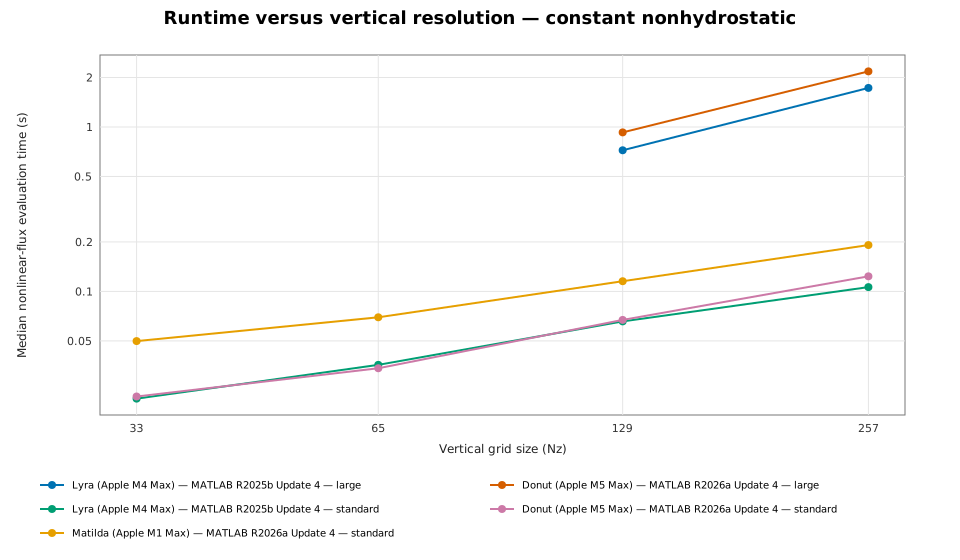
View all benchmark data
| Suite | Transform | Dataset | Resolution | Value | Status | Reason |
|---|---|---|---|---|---|---|
| scaling-large-v1 | Constant hydrostatic | Donut (Apple M5 Max) — WaveVortexModel MATLAB 4.2.1 (builtin; MATLAB 26.1.0.3312084 (R2026a) Update 4) — scaling-large-v1 | 129 | 0.816 s | complete | — |
| scaling-large-v1 | Constant hydrostatic | Lyra (Apple M4 Max) — WaveVortexModel MATLAB 4.2.1 (builtin; MATLAB 25.2.0.3150157 (R2025b) Update 4) — scaling-large-v1 | 129 | 0.6859 s | complete | — |
| scaling-large-v1 | Constant hydrostatic | Matilda (Apple M1 Max) — WaveVortexModel MATLAB 4.2.1 (builtin; MATLAB 26.1.0.3312084 (R2026a) Update 4) — scaling-large-v1 | 129 | Unavailable | unavailable | No scaling-large-v1 dataset was collected for this environment. |
| scaling-large-v1 | Constant hydrostatic | Donut (Apple M5 Max) — WaveVortexModel MATLAB 4.2.1 (builtin; MATLAB 26.1.0.3312084 (R2026a) Update 4) — scaling-large-v1 | 257 | 1.801 s | complete | — |
| scaling-large-v1 | Constant hydrostatic | Lyra (Apple M4 Max) — WaveVortexModel MATLAB 4.2.1 (builtin; MATLAB 25.2.0.3150157 (R2025b) Update 4) — scaling-large-v1 | 257 | 1.43 s | complete | — |
| scaling-large-v1 | Constant hydrostatic | Matilda (Apple M1 Max) — WaveVortexModel MATLAB 4.2.1 (builtin; MATLAB 26.1.0.3312084 (R2026a) Update 4) — scaling-large-v1 | 257 | Unavailable | unavailable | No scaling-large-v1 dataset was collected for this environment. |
| scaling-large-v1 | Constant nonhydrostatic | Donut (Apple M5 Max) — WaveVortexModel MATLAB 4.2.1 (builtin; MATLAB 26.1.0.3312084 (R2026a) Update 4) — scaling-large-v1 | 129 | 0.9271 s | complete | — |
| scaling-large-v1 | Constant nonhydrostatic | Lyra (Apple M4 Max) — WaveVortexModel MATLAB 4.2.1 (builtin; MATLAB 25.2.0.3150157 (R2025b) Update 4) — scaling-large-v1 | 129 | 0.7217 s | complete | — |
| scaling-large-v1 | Constant nonhydrostatic | Matilda (Apple M1 Max) — WaveVortexModel MATLAB 4.2.1 (builtin; MATLAB 26.1.0.3312084 (R2026a) Update 4) — scaling-large-v1 | 129 | Unavailable | unavailable | No scaling-large-v1 dataset was collected for this environment. |
| scaling-large-v1 | Constant nonhydrostatic | Donut (Apple M5 Max) — WaveVortexModel MATLAB 4.2.1 (builtin; MATLAB 26.1.0.3312084 (R2026a) Update 4) — scaling-large-v1 | 257 | 2.179 s | complete | — |
| scaling-large-v1 | Constant nonhydrostatic | Lyra (Apple M4 Max) — WaveVortexModel MATLAB 4.2.1 (builtin; MATLAB 25.2.0.3150157 (R2025b) Update 4) — scaling-large-v1 | 257 | 1.728 s | complete | — |
| scaling-large-v1 | Constant nonhydrostatic | Matilda (Apple M1 Max) — WaveVortexModel MATLAB 4.2.1 (builtin; MATLAB 26.1.0.3312084 (R2026a) Update 4) — scaling-large-v1 | 257 | Unavailable | unavailable | No scaling-large-v1 dataset was collected for this environment. |
| scaling-large-v1 | Stratified QG | Donut (Apple M5 Max) — WaveVortexModel MATLAB 4.2.1 (builtin; MATLAB 26.1.0.3312084 (R2026a) Update 4) — scaling-large-v1 | 129 | 0.248 s | complete | — |
| scaling-large-v1 | Stratified QG | Lyra (Apple M4 Max) — WaveVortexModel MATLAB 4.2.1 (builtin; MATLAB 25.2.0.3150157 (R2025b) Update 4) — scaling-large-v1 | 129 | 0.2291 s | complete | — |
| scaling-large-v1 | Stratified QG | Matilda (Apple M1 Max) — WaveVortexModel MATLAB 4.2.1 (builtin; MATLAB 26.1.0.3312084 (R2026a) Update 4) — scaling-large-v1 | 129 | Unavailable | unavailable | No scaling-large-v1 dataset was collected for this environment. |
| scaling-large-v1 | Stratified QG | Donut (Apple M5 Max) — WaveVortexModel MATLAB 4.2.1 (builtin; MATLAB 26.1.0.3312084 (R2026a) Update 4) — scaling-large-v1 | 257 | 0.5596 s | complete | — |
| scaling-large-v1 | Stratified QG | Lyra (Apple M4 Max) — WaveVortexModel MATLAB 4.2.1 (builtin; MATLAB 25.2.0.3150157 (R2025b) Update 4) — scaling-large-v1 | 257 | 0.4844 s | complete | — |
| scaling-large-v1 | Stratified QG | Matilda (Apple M1 Max) — WaveVortexModel MATLAB 4.2.1 (builtin; MATLAB 26.1.0.3312084 (R2026a) Update 4) — scaling-large-v1 | 257 | Unavailable | unavailable | No scaling-large-v1 dataset was collected for this environment. |
| scaling-large-v1 | Variable Boussinesq | Donut (Apple M5 Max) — WaveVortexModel MATLAB 4.2.1 (builtin; MATLAB 26.1.0.3312084 (R2026a) Update 4) — scaling-large-v1 | 129 | 1.54 s | complete | — |
| scaling-large-v1 | Variable Boussinesq | Lyra (Apple M4 Max) — WaveVortexModel MATLAB 4.2.1 (builtin; MATLAB 25.2.0.3150157 (R2025b) Update 4) — scaling-large-v1 | 129 | 1.597 s | complete | — |
| scaling-large-v1 | Variable Boussinesq | Matilda (Apple M1 Max) — WaveVortexModel MATLAB 4.2.1 (builtin; MATLAB 26.1.0.3312084 (R2026a) Update 4) — scaling-large-v1 | 129 | Unavailable | unavailable | No scaling-large-v1 dataset was collected for this environment. |
| scaling-large-v1 | Variable Boussinesq | Donut (Apple M5 Max) — WaveVortexModel MATLAB 4.2.1 (builtin; MATLAB 26.1.0.3312084 (R2026a) Update 4) — scaling-large-v1 | 257 | Unavailable | unavailable | Not collected on this 48 GiB host because the observed memory requirement left insufficient safety margin. |
| scaling-large-v1 | Variable Boussinesq | Lyra (Apple M4 Max) — WaveVortexModel MATLAB 4.2.1 (builtin; MATLAB 25.2.0.3150157 (R2025b) Update 4) — scaling-large-v1 | 257 | 3.508 s | complete | — |
| scaling-large-v1 | Variable Boussinesq | Matilda (Apple M1 Max) — WaveVortexModel MATLAB 4.2.1 (builtin; MATLAB 26.1.0.3312084 (R2026a) Update 4) — scaling-large-v1 | 257 | Unavailable | unavailable | No scaling-large-v1 dataset was collected for this environment. |
| scaling-large-v1 | Variable hydrostatic | Donut (Apple M5 Max) — WaveVortexModel MATLAB 4.2.1 (builtin; MATLAB 26.1.0.3312084 (R2026a) Update 4) — scaling-large-v1 | 129 | 0.7167 s | complete | — |
| scaling-large-v1 | Variable hydrostatic | Lyra (Apple M4 Max) — WaveVortexModel MATLAB 4.2.1 (builtin; MATLAB 25.2.0.3150157 (R2025b) Update 4) — scaling-large-v1 | 129 | 0.66 s | complete | — |
| scaling-large-v1 | Variable hydrostatic | Matilda (Apple M1 Max) — WaveVortexModel MATLAB 4.2.1 (builtin; MATLAB 26.1.0.3312084 (R2026a) Update 4) — scaling-large-v1 | 129 | Unavailable | unavailable | No scaling-large-v1 dataset was collected for this environment. |
| scaling-large-v1 | Variable hydrostatic | Donut (Apple M5 Max) — WaveVortexModel MATLAB 4.2.1 (builtin; MATLAB 26.1.0.3312084 (R2026a) Update 4) — scaling-large-v1 | 257 | 1.642 s | complete | — |
| scaling-large-v1 | Variable hydrostatic | Lyra (Apple M4 Max) — WaveVortexModel MATLAB 4.2.1 (builtin; MATLAB 25.2.0.3150157 (R2025b) Update 4) — scaling-large-v1 | 257 | 1.356 s | complete | — |
| scaling-large-v1 | Variable hydrostatic | Matilda (Apple M1 Max) — WaveVortexModel MATLAB 4.2.1 (builtin; MATLAB 26.1.0.3312084 (R2026a) Update 4) — scaling-large-v1 | 257 | Unavailable | unavailable | No scaling-large-v1 dataset was collected for this environment. |
| scaling-standard-v1 | Constant hydrostatic | Donut (Apple M5 Max) — WaveVortexModel MATLAB 4.2.1 (builtin; MATLAB 26.1.0.3312084 (R2026a) Update 4) — scaling-standard-v1 | 129 | 0.0498 s | complete | — |
| scaling-standard-v1 | Constant hydrostatic | Lyra (Apple M4 Max) — WaveVortexModel MATLAB 4.2.1 (builtin; MATLAB 25.2.0.3150157 (R2025b) Update 4) — scaling-standard-v1 | 129 | 0.04905 s | complete | — |
| scaling-standard-v1 | Constant hydrostatic | Matilda (Apple M1 Max) — WaveVortexModel MATLAB 4.2.1 (builtin; MATLAB 26.1.0.3312084 (R2026a) Update 4) — scaling-standard-v1 | 129 | 0.08932 s | complete | — |
| scaling-standard-v1 | Constant hydrostatic | Donut (Apple M5 Max) — WaveVortexModel MATLAB 4.2.1 (builtin; MATLAB 26.1.0.3312084 (R2026a) Update 4) — scaling-standard-v1 | 257 | 0.1009 s | complete | — |
| scaling-standard-v1 | Constant hydrostatic | Lyra (Apple M4 Max) — WaveVortexModel MATLAB 4.2.1 (builtin; MATLAB 25.2.0.3150157 (R2025b) Update 4) — scaling-standard-v1 | 257 | 0.08696 s | complete | — |
| scaling-standard-v1 | Constant hydrostatic | Matilda (Apple M1 Max) — WaveVortexModel MATLAB 4.2.1 (builtin; MATLAB 26.1.0.3312084 (R2026a) Update 4) — scaling-standard-v1 | 257 | 0.1628 s | complete | — |
| scaling-standard-v1 | Constant hydrostatic | Donut (Apple M5 Max) — WaveVortexModel MATLAB 4.2.1 (builtin; MATLAB 26.1.0.3312084 (R2026a) Update 4) — scaling-standard-v1 | 33 | 0.01933 s | complete | — |
| scaling-standard-v1 | Constant hydrostatic | Lyra (Apple M4 Max) — WaveVortexModel MATLAB 4.2.1 (builtin; MATLAB 25.2.0.3150157 (R2025b) Update 4) — scaling-standard-v1 | 33 | 0.01874 s | complete | — |
| scaling-standard-v1 | Constant hydrostatic | Matilda (Apple M1 Max) — WaveVortexModel MATLAB 4.2.1 (builtin; MATLAB 26.1.0.3312084 (R2026a) Update 4) — scaling-standard-v1 | 33 | 0.0365 s | complete | — |
| scaling-standard-v1 | Constant hydrostatic | Donut (Apple M5 Max) — WaveVortexModel MATLAB 4.2.1 (builtin; MATLAB 26.1.0.3312084 (R2026a) Update 4) — scaling-standard-v1 | 65 | 0.02826 s | complete | — |
| scaling-standard-v1 | Constant hydrostatic | Lyra (Apple M4 Max) — WaveVortexModel MATLAB 4.2.1 (builtin; MATLAB 25.2.0.3150157 (R2025b) Update 4) — scaling-standard-v1 | 65 | 0.02966 s | complete | — |
| scaling-standard-v1 | Constant hydrostatic | Matilda (Apple M1 Max) — WaveVortexModel MATLAB 4.2.1 (builtin; MATLAB 26.1.0.3312084 (R2026a) Update 4) — scaling-standard-v1 | 65 | 0.05619 s | complete | — |
| scaling-standard-v1 | Constant nonhydrostatic | Donut (Apple M5 Max) — WaveVortexModel MATLAB 4.2.1 (builtin; MATLAB 26.1.0.3312084 (R2026a) Update 4) — scaling-standard-v1 | 129 | 0.06709 s | complete | — |
| scaling-standard-v1 | Constant nonhydrostatic | Lyra (Apple M4 Max) — WaveVortexModel MATLAB 4.2.1 (builtin; MATLAB 25.2.0.3150157 (R2025b) Update 4) — scaling-standard-v1 | 129 | 0.06571 s | complete | — |
| scaling-standard-v1 | Constant nonhydrostatic | Matilda (Apple M1 Max) — WaveVortexModel MATLAB 4.2.1 (builtin; MATLAB 26.1.0.3312084 (R2026a) Update 4) — scaling-standard-v1 | 129 | 0.1153 s | complete | — |
| scaling-standard-v1 | Constant nonhydrostatic | Donut (Apple M5 Max) — WaveVortexModel MATLAB 4.2.1 (builtin; MATLAB 26.1.0.3312084 (R2026a) Update 4) — scaling-standard-v1 | 257 | 0.1235 s | complete | — |
| scaling-standard-v1 | Constant nonhydrostatic | Lyra (Apple M4 Max) — WaveVortexModel MATLAB 4.2.1 (builtin; MATLAB 25.2.0.3150157 (R2025b) Update 4) — scaling-standard-v1 | 257 | 0.1062 s | complete | — |
| scaling-standard-v1 | Constant nonhydrostatic | Matilda (Apple M1 Max) — WaveVortexModel MATLAB 4.2.1 (builtin; MATLAB 26.1.0.3312084 (R2026a) Update 4) — scaling-standard-v1 | 257 | 0.1914 s | complete | — |
| scaling-standard-v1 | Constant nonhydrostatic | Donut (Apple M5 Max) — WaveVortexModel MATLAB 4.2.1 (builtin; MATLAB 26.1.0.3312084 (R2026a) Update 4) — scaling-standard-v1 | 33 | 0.02295 s | complete | — |
| scaling-standard-v1 | Constant nonhydrostatic | Lyra (Apple M4 Max) — WaveVortexModel MATLAB 4.2.1 (builtin; MATLAB 25.2.0.3150157 (R2025b) Update 4) — scaling-standard-v1 | 33 | 0.02228 s | complete | — |
| scaling-standard-v1 | Constant nonhydrostatic | Matilda (Apple M1 Max) — WaveVortexModel MATLAB 4.2.1 (builtin; MATLAB 26.1.0.3312084 (R2026a) Update 4) — scaling-standard-v1 | 33 | 0.04987 s | complete | — |
| scaling-standard-v1 | Constant nonhydrostatic | Donut (Apple M5 Max) — WaveVortexModel MATLAB 4.2.1 (builtin; MATLAB 26.1.0.3312084 (R2026a) Update 4) — scaling-standard-v1 | 65 | 0.03409 s | complete | — |
| scaling-standard-v1 | Constant nonhydrostatic | Lyra (Apple M4 Max) — WaveVortexModel MATLAB 4.2.1 (builtin; MATLAB 25.2.0.3150157 (R2025b) Update 4) — scaling-standard-v1 | 65 | 0.03576 s | complete | — |
| scaling-standard-v1 | Constant nonhydrostatic | Matilda (Apple M1 Max) — WaveVortexModel MATLAB 4.2.1 (builtin; MATLAB 26.1.0.3312084 (R2026a) Update 4) — scaling-standard-v1 | 65 | 0.0696 s | complete | — |
| scaling-standard-v1 | Stratified QG | Donut (Apple M5 Max) — WaveVortexModel MATLAB 4.2.1 (builtin; MATLAB 26.1.0.3312084 (R2026a) Update 4) — scaling-standard-v1 | 129 | 0.01775 s | complete | — |
| scaling-standard-v1 | Stratified QG | Lyra (Apple M4 Max) — WaveVortexModel MATLAB 4.2.1 (builtin; MATLAB 25.2.0.3150157 (R2025b) Update 4) — scaling-standard-v1 | 129 | 0.01803 s | complete | — |
| scaling-standard-v1 | Stratified QG | Matilda (Apple M1 Max) — WaveVortexModel MATLAB 4.2.1 (builtin; MATLAB 26.1.0.3312084 (R2026a) Update 4) — scaling-standard-v1 | 129 | 0.03102 s | complete | — |
| scaling-standard-v1 | Stratified QG | Donut (Apple M5 Max) — WaveVortexModel MATLAB 4.2.1 (builtin; MATLAB 26.1.0.3312084 (R2026a) Update 4) — scaling-standard-v1 | 257 | 0.03073 s | complete | — |
| scaling-standard-v1 | Stratified QG | Lyra (Apple M4 Max) — WaveVortexModel MATLAB 4.2.1 (builtin; MATLAB 25.2.0.3150157 (R2025b) Update 4) — scaling-standard-v1 | 257 | 0.02928 s | complete | — |
| scaling-standard-v1 | Stratified QG | Matilda (Apple M1 Max) — WaveVortexModel MATLAB 4.2.1 (builtin; MATLAB 26.1.0.3312084 (R2026a) Update 4) — scaling-standard-v1 | 257 | 0.05096 s | complete | — |
| scaling-standard-v1 | Stratified QG | Donut (Apple M5 Max) — WaveVortexModel MATLAB 4.2.1 (builtin; MATLAB 26.1.0.3312084 (R2026a) Update 4) — scaling-standard-v1 | 33 | 0.006398 s | complete | — |
| scaling-standard-v1 | Stratified QG | Lyra (Apple M4 Max) — WaveVortexModel MATLAB 4.2.1 (builtin; MATLAB 25.2.0.3150157 (R2025b) Update 4) — scaling-standard-v1 | 33 | 0.006322 s | complete | — |
| scaling-standard-v1 | Stratified QG | Matilda (Apple M1 Max) — WaveVortexModel MATLAB 4.2.1 (builtin; MATLAB 26.1.0.3312084 (R2026a) Update 4) — scaling-standard-v1 | 33 | 0.01132 s | complete | — |
| scaling-standard-v1 | Stratified QG | Donut (Apple M5 Max) — WaveVortexModel MATLAB 4.2.1 (builtin; MATLAB 26.1.0.3312084 (R2026a) Update 4) — scaling-standard-v1 | 65 | 0.009861 s | complete | — |
| scaling-standard-v1 | Stratified QG | Lyra (Apple M4 Max) — WaveVortexModel MATLAB 4.2.1 (builtin; MATLAB 25.2.0.3150157 (R2025b) Update 4) — scaling-standard-v1 | 65 | 0.01117 s | complete | — |
| scaling-standard-v1 | Stratified QG | Matilda (Apple M1 Max) — WaveVortexModel MATLAB 4.2.1 (builtin; MATLAB 26.1.0.3312084 (R2026a) Update 4) — scaling-standard-v1 | 65 | 0.02029 s | complete | — |
| scaling-standard-v1 | Variable Boussinesq | Donut (Apple M5 Max) — WaveVortexModel MATLAB 4.2.1 (builtin; MATLAB 26.1.0.3312084 (R2026a) Update 4) — scaling-standard-v1 | 129 | 0.1068 s | complete | — |
| scaling-standard-v1 | Variable Boussinesq | Lyra (Apple M4 Max) — WaveVortexModel MATLAB 4.2.1 (builtin; MATLAB 25.2.0.3150157 (R2025b) Update 4) — scaling-standard-v1 | 129 | 0.1163 s | complete | — |
| scaling-standard-v1 | Variable Boussinesq | Matilda (Apple M1 Max) — WaveVortexModel MATLAB 4.2.1 (builtin; MATLAB 26.1.0.3312084 (R2026a) Update 4) — scaling-standard-v1 | 129 | 0.2006 s | complete | — |
| scaling-standard-v1 | Variable Boussinesq | Donut (Apple M5 Max) — WaveVortexModel MATLAB 4.2.1 (builtin; MATLAB 26.1.0.3312084 (R2026a) Update 4) — scaling-standard-v1 | 257 | 0.2396 s | complete | — |
| scaling-standard-v1 | Variable Boussinesq | Lyra (Apple M4 Max) — WaveVortexModel MATLAB 4.2.1 (builtin; MATLAB 25.2.0.3150157 (R2025b) Update 4) — scaling-standard-v1 | 257 | 0.2426 s | complete | — |
| scaling-standard-v1 | Variable Boussinesq | Matilda (Apple M1 Max) — WaveVortexModel MATLAB 4.2.1 (builtin; MATLAB 26.1.0.3312084 (R2026a) Update 4) — scaling-standard-v1 | 257 | 0.4833 s | complete | — |
| scaling-standard-v1 | Variable Boussinesq | Donut (Apple M5 Max) — WaveVortexModel MATLAB 4.2.1 (builtin; MATLAB 26.1.0.3312084 (R2026a) Update 4) — scaling-standard-v1 | 33 | 0.02798 s | complete | — |
| scaling-standard-v1 | Variable Boussinesq | Lyra (Apple M4 Max) — WaveVortexModel MATLAB 4.2.1 (builtin; MATLAB 25.2.0.3150157 (R2025b) Update 4) — scaling-standard-v1 | 33 | 0.03268 s | complete | — |
| scaling-standard-v1 | Variable Boussinesq | Matilda (Apple M1 Max) — WaveVortexModel MATLAB 4.2.1 (builtin; MATLAB 26.1.0.3312084 (R2026a) Update 4) — scaling-standard-v1 | 33 | 0.05663 s | complete | — |
| scaling-standard-v1 | Variable Boussinesq | Donut (Apple M5 Max) — WaveVortexModel MATLAB 4.2.1 (builtin; MATLAB 26.1.0.3312084 (R2026a) Update 4) — scaling-standard-v1 | 65 | 0.05228 s | complete | — |
| scaling-standard-v1 | Variable Boussinesq | Lyra (Apple M4 Max) — WaveVortexModel MATLAB 4.2.1 (builtin; MATLAB 25.2.0.3150157 (R2025b) Update 4) — scaling-standard-v1 | 65 | 0.05764 s | complete | — |
| scaling-standard-v1 | Variable Boussinesq | Matilda (Apple M1 Max) — WaveVortexModel MATLAB 4.2.1 (builtin; MATLAB 26.1.0.3312084 (R2026a) Update 4) — scaling-standard-v1 | 65 | 0.1045 s | complete | — |
| scaling-standard-v1 | Variable hydrostatic | Donut (Apple M5 Max) — WaveVortexModel MATLAB 4.2.1 (builtin; MATLAB 26.1.0.3312084 (R2026a) Update 4) — scaling-standard-v1 | 129 | 0.04556 s | complete | — |
| scaling-standard-v1 | Variable hydrostatic | Lyra (Apple M4 Max) — WaveVortexModel MATLAB 4.2.1 (builtin; MATLAB 25.2.0.3150157 (R2025b) Update 4) — scaling-standard-v1 | 129 | 0.04562 s | complete | — |
| scaling-standard-v1 | Variable hydrostatic | Matilda (Apple M1 Max) — WaveVortexModel MATLAB 4.2.1 (builtin; MATLAB 26.1.0.3312084 (R2026a) Update 4) — scaling-standard-v1 | 129 | 0.08205 s | complete | — |
| scaling-standard-v1 | Variable hydrostatic | Donut (Apple M5 Max) — WaveVortexModel MATLAB 4.2.1 (builtin; MATLAB 26.1.0.3312084 (R2026a) Update 4) — scaling-standard-v1 | 257 | 0.0917 s | complete | — |
| scaling-standard-v1 | Variable hydrostatic | Lyra (Apple M4 Max) — WaveVortexModel MATLAB 4.2.1 (builtin; MATLAB 25.2.0.3150157 (R2025b) Update 4) — scaling-standard-v1 | 257 | 0.08277 s | complete | — |
| scaling-standard-v1 | Variable hydrostatic | Matilda (Apple M1 Max) — WaveVortexModel MATLAB 4.2.1 (builtin; MATLAB 26.1.0.3312084 (R2026a) Update 4) — scaling-standard-v1 | 257 | 0.1551 s | complete | — |
| scaling-standard-v1 | Variable hydrostatic | Donut (Apple M5 Max) — WaveVortexModel MATLAB 4.2.1 (builtin; MATLAB 26.1.0.3312084 (R2026a) Update 4) — scaling-standard-v1 | 33 | 0.01616 s | complete | — |
| scaling-standard-v1 | Variable hydrostatic | Lyra (Apple M4 Max) — WaveVortexModel MATLAB 4.2.1 (builtin; MATLAB 25.2.0.3150157 (R2025b) Update 4) — scaling-standard-v1 | 33 | 0.01546 s | complete | — |
| scaling-standard-v1 | Variable hydrostatic | Matilda (Apple M1 Max) — WaveVortexModel MATLAB 4.2.1 (builtin; MATLAB 26.1.0.3312084 (R2026a) Update 4) — scaling-standard-v1 | 33 | 0.03153 s | complete | — |
| scaling-standard-v1 | Variable hydrostatic | Donut (Apple M5 Max) — WaveVortexModel MATLAB 4.2.1 (builtin; MATLAB 26.1.0.3312084 (R2026a) Update 4) — scaling-standard-v1 | 65 | 0.02623 s | complete | — |
| scaling-standard-v1 | Variable hydrostatic | Lyra (Apple M4 Max) — WaveVortexModel MATLAB 4.2.1 (builtin; MATLAB 25.2.0.3150157 (R2025b) Update 4) — scaling-standard-v1 | 65 | 0.02721 s | complete | — |
| scaling-standard-v1 | Variable hydrostatic | Matilda (Apple M1 Max) — WaveVortexModel MATLAB 4.2.1 (builtin; MATLAB 26.1.0.3312084 (R2026a) Update 4) — scaling-standard-v1 | 65 | 0.05178 s | complete | — |
MATLAB memory scaling
Setup. These historical tests repeat the same model, operation, and horizontal and vertical resolution sweeps used above; only the reported metric changes to peak MATLAB process memory, including the language runtime and numerical libraries. The separate MATLAB builtin transform storage benchmark inventories known application-owned arrays without treating them as total process memory.
Conclusion. Within these MATLAB builtin records, horizontal refinement is also the stronger memory constraint: at large resolutions, doubling both horizontal dimensions increases peak memory by roughly three- to fourfold, while doubling the vertical resolution approximately doubles it. Exact storage ledgers and process RSS answer different questions and must not be combined into a synthetic memory estimate.
Peak process memory versus horizontal resolution
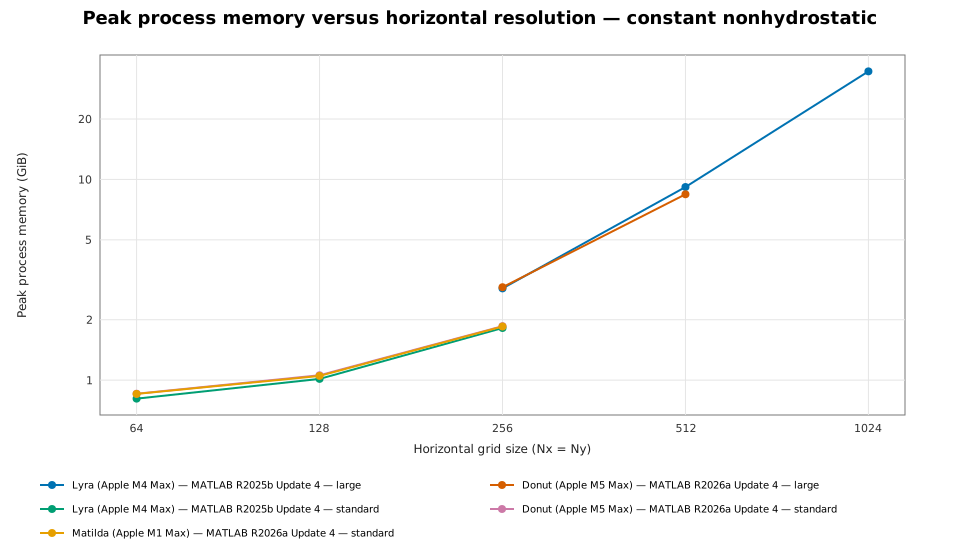
View all benchmark data
| Suite | Transform | Dataset | Resolution | Value | Status | Reason |
|---|---|---|---|---|---|---|
| scaling-large-v1 | Barotropic QG | Donut (Apple M5 Max) — WaveVortexModel MATLAB 4.2.1 (builtin; MATLAB 26.1.0.3312084 (R2026a) Update 4) — scaling-large-v1 | 2048 | 1.57 GiB | complete | — |
| scaling-large-v1 | Barotropic QG | Lyra (Apple M4 Max) — WaveVortexModel MATLAB 4.2.1 (builtin; MATLAB 25.2.0.3150157 (R2025b) Update 4) — scaling-large-v1 | 2048 | 1.55 GiB | complete | — |
| scaling-large-v1 | Barotropic QG | Matilda (Apple M1 Max) — WaveVortexModel MATLAB 4.2.1 (builtin; MATLAB 26.1.0.3312084 (R2026a) Update 4) — scaling-large-v1 | 2048 | Unavailable | unavailable | No scaling-large-v1 dataset was collected for this environment. |
| scaling-large-v1 | Barotropic QG | Donut (Apple M5 Max) — WaveVortexModel MATLAB 4.2.1 (builtin; MATLAB 26.1.0.3312084 (R2026a) Update 4) — scaling-large-v1 | 4096 | 4.11 GiB | complete | — |
| scaling-large-v1 | Barotropic QG | Lyra (Apple M4 Max) — WaveVortexModel MATLAB 4.2.1 (builtin; MATLAB 25.2.0.3150157 (R2025b) Update 4) — scaling-large-v1 | 4096 | 3.96 GiB | complete | — |
| scaling-large-v1 | Barotropic QG | Matilda (Apple M1 Max) — WaveVortexModel MATLAB 4.2.1 (builtin; MATLAB 26.1.0.3312084 (R2026a) Update 4) — scaling-large-v1 | 4096 | Unavailable | unavailable | No scaling-large-v1 dataset was collected for this environment. |
| scaling-large-v1 | Constant hydrostatic | Donut (Apple M5 Max) — WaveVortexModel MATLAB 4.2.1 (builtin; MATLAB 26.1.0.3312084 (R2026a) Update 4) — scaling-large-v1 | 1024 | Unavailable | unavailable | Not collected on this 48 GiB host because the observed memory requirement left insufficient safety margin. |
| scaling-large-v1 | Constant hydrostatic | Lyra (Apple M4 Max) — WaveVortexModel MATLAB 4.2.1 (builtin; MATLAB 25.2.0.3150157 (R2025b) Update 4) — scaling-large-v1 | 1024 | 32.8 GiB | complete | — |
| scaling-large-v1 | Constant hydrostatic | Matilda (Apple M1 Max) — WaveVortexModel MATLAB 4.2.1 (builtin; MATLAB 26.1.0.3312084 (R2026a) Update 4) — scaling-large-v1 | 1024 | Unavailable | unavailable | No scaling-large-v1 dataset was collected for this environment. |
| scaling-large-v1 | Constant hydrostatic | Donut (Apple M5 Max) — WaveVortexModel MATLAB 4.2.1 (builtin; MATLAB 26.1.0.3312084 (R2026a) Update 4) — scaling-large-v1 | 256 | 2.8 GiB | complete | — |
| scaling-large-v1 | Constant hydrostatic | Lyra (Apple M4 Max) — WaveVortexModel MATLAB 4.2.1 (builtin; MATLAB 25.2.0.3150157 (R2025b) Update 4) — scaling-large-v1 | 256 | 2.75 GiB | complete | — |
| scaling-large-v1 | Constant hydrostatic | Matilda (Apple M1 Max) — WaveVortexModel MATLAB 4.2.1 (builtin; MATLAB 26.1.0.3312084 (R2026a) Update 4) — scaling-large-v1 | 256 | Unavailable | unavailable | No scaling-large-v1 dataset was collected for this environment. |
| scaling-large-v1 | Constant hydrostatic | Donut (Apple M5 Max) — WaveVortexModel MATLAB 4.2.1 (builtin; MATLAB 26.1.0.3312084 (R2026a) Update 4) — scaling-large-v1 | 512 | 8.79 GiB | complete | — |
| scaling-large-v1 | Constant hydrostatic | Lyra (Apple M4 Max) — WaveVortexModel MATLAB 4.2.1 (builtin; MATLAB 25.2.0.3150157 (R2025b) Update 4) — scaling-large-v1 | 512 | 8.74 GiB | complete | — |
| scaling-large-v1 | Constant hydrostatic | Matilda (Apple M1 Max) — WaveVortexModel MATLAB 4.2.1 (builtin; MATLAB 26.1.0.3312084 (R2026a) Update 4) — scaling-large-v1 | 512 | Unavailable | unavailable | No scaling-large-v1 dataset was collected for this environment. |
| scaling-large-v1 | Constant nonhydrostatic | Donut (Apple M5 Max) — WaveVortexModel MATLAB 4.2.1 (builtin; MATLAB 26.1.0.3312084 (R2026a) Update 4) — scaling-large-v1 | 1024 | Unavailable | unavailable | Not collected on this 48 GiB host because the observed memory requirement left insufficient safety margin. |
| scaling-large-v1 | Constant nonhydrostatic | Lyra (Apple M4 Max) — WaveVortexModel MATLAB 4.2.1 (builtin; MATLAB 25.2.0.3150157 (R2025b) Update 4) — scaling-large-v1 | 1024 | 34.6 GiB | complete | — |
| scaling-large-v1 | Constant nonhydrostatic | Matilda (Apple M1 Max) — WaveVortexModel MATLAB 4.2.1 (builtin; MATLAB 26.1.0.3312084 (R2026a) Update 4) — scaling-large-v1 | 1024 | Unavailable | unavailable | No scaling-large-v1 dataset was collected for this environment. |
| scaling-large-v1 | Constant nonhydrostatic | Donut (Apple M5 Max) — WaveVortexModel MATLAB 4.2.1 (builtin; MATLAB 26.1.0.3312084 (R2026a) Update 4) — scaling-large-v1 | 256 | 2.9 GiB | complete | — |
| scaling-large-v1 | Constant nonhydrostatic | Lyra (Apple M4 Max) — WaveVortexModel MATLAB 4.2.1 (builtin; MATLAB 25.2.0.3150157 (R2025b) Update 4) — scaling-large-v1 | 256 | 2.86 GiB | complete | — |
| scaling-large-v1 | Constant nonhydrostatic | Matilda (Apple M1 Max) — WaveVortexModel MATLAB 4.2.1 (builtin; MATLAB 26.1.0.3312084 (R2026a) Update 4) — scaling-large-v1 | 256 | Unavailable | unavailable | No scaling-large-v1 dataset was collected for this environment. |
| scaling-large-v1 | Constant nonhydrostatic | Donut (Apple M5 Max) — WaveVortexModel MATLAB 4.2.1 (builtin; MATLAB 26.1.0.3312084 (R2026a) Update 4) — scaling-large-v1 | 512 | 8.43 GiB | complete | — |
| scaling-large-v1 | Constant nonhydrostatic | Lyra (Apple M4 Max) — WaveVortexModel MATLAB 4.2.1 (builtin; MATLAB 25.2.0.3150157 (R2025b) Update 4) — scaling-large-v1 | 512 | 9.17 GiB | complete | — |
| scaling-large-v1 | Constant nonhydrostatic | Matilda (Apple M1 Max) — WaveVortexModel MATLAB 4.2.1 (builtin; MATLAB 26.1.0.3312084 (R2026a) Update 4) — scaling-large-v1 | 512 | Unavailable | unavailable | No scaling-large-v1 dataset was collected for this environment. |
| scaling-large-v1 | Stratified QG | Donut (Apple M5 Max) — WaveVortexModel MATLAB 4.2.1 (builtin; MATLAB 26.1.0.3312084 (R2026a) Update 4) — scaling-large-v1 | 256 | 1.79 GiB | complete | — |
| scaling-large-v1 | Stratified QG | Lyra (Apple M4 Max) — WaveVortexModel MATLAB 4.2.1 (builtin; MATLAB 25.2.0.3150157 (R2025b) Update 4) — scaling-large-v1 | 256 | 1.75 GiB | complete | — |
| scaling-large-v1 | Stratified QG | Matilda (Apple M1 Max) — WaveVortexModel MATLAB 4.2.1 (builtin; MATLAB 26.1.0.3312084 (R2026a) Update 4) — scaling-large-v1 | 256 | Unavailable | unavailable | No scaling-large-v1 dataset was collected for this environment. |
| scaling-large-v1 | Stratified QG | Donut (Apple M5 Max) — WaveVortexModel MATLAB 4.2.1 (builtin; MATLAB 26.1.0.3312084 (R2026a) Update 4) — scaling-large-v1 | 512 | 4.77 GiB | complete | — |
| scaling-large-v1 | Stratified QG | Lyra (Apple M4 Max) — WaveVortexModel MATLAB 4.2.1 (builtin; MATLAB 25.2.0.3150157 (R2025b) Update 4) — scaling-large-v1 | 512 | 4.73 GiB | complete | — |
| scaling-large-v1 | Stratified QG | Matilda (Apple M1 Max) — WaveVortexModel MATLAB 4.2.1 (builtin; MATLAB 26.1.0.3312084 (R2026a) Update 4) — scaling-large-v1 | 512 | Unavailable | unavailable | No scaling-large-v1 dataset was collected for this environment. |
| scaling-large-v1 | Variable Boussinesq | Donut (Apple M5 Max) — WaveVortexModel MATLAB 4.2.1 (builtin; MATLAB 26.1.0.3312084 (R2026a) Update 4) — scaling-large-v1 | 256 | 3.86 GiB | complete | — |
| scaling-large-v1 | Variable Boussinesq | Lyra (Apple M4 Max) — WaveVortexModel MATLAB 4.2.1 (builtin; MATLAB 25.2.0.3150157 (R2025b) Update 4) — scaling-large-v1 | 256 | 3.75 GiB | complete | — |
| scaling-large-v1 | Variable Boussinesq | Matilda (Apple M1 Max) — WaveVortexModel MATLAB 4.2.1 (builtin; MATLAB 26.1.0.3312084 (R2026a) Update 4) — scaling-large-v1 | 256 | Unavailable | unavailable | No scaling-large-v1 dataset was collected for this environment. |
| scaling-large-v1 | Variable Boussinesq | Donut (Apple M5 Max) — WaveVortexModel MATLAB 4.2.1 (builtin; MATLAB 26.1.0.3312084 (R2026a) Update 4) — scaling-large-v1 | 512 | 10.6 GiB | complete | — |
| scaling-large-v1 | Variable Boussinesq | Lyra (Apple M4 Max) — WaveVortexModel MATLAB 4.2.1 (builtin; MATLAB 25.2.0.3150157 (R2025b) Update 4) — scaling-large-v1 | 512 | 12.3 GiB | complete | — |
| scaling-large-v1 | Variable Boussinesq | Matilda (Apple M1 Max) — WaveVortexModel MATLAB 4.2.1 (builtin; MATLAB 26.1.0.3312084 (R2026a) Update 4) — scaling-large-v1 | 512 | Unavailable | unavailable | No scaling-large-v1 dataset was collected for this environment. |
| scaling-large-v1 | Variable hydrostatic | Donut (Apple M5 Max) — WaveVortexModel MATLAB 4.2.1 (builtin; MATLAB 26.1.0.3312084 (R2026a) Update 4) — scaling-large-v1 | 256 | 2.76 GiB | complete | — |
| scaling-large-v1 | Variable hydrostatic | Lyra (Apple M4 Max) — WaveVortexModel MATLAB 4.2.1 (builtin; MATLAB 25.2.0.3150157 (R2025b) Update 4) — scaling-large-v1 | 256 | 2.71 GiB | complete | — |
| scaling-large-v1 | Variable hydrostatic | Matilda (Apple M1 Max) — WaveVortexModel MATLAB 4.2.1 (builtin; MATLAB 26.1.0.3312084 (R2026a) Update 4) — scaling-large-v1 | 256 | Unavailable | unavailable | No scaling-large-v1 dataset was collected for this environment. |
| scaling-large-v1 | Variable hydrostatic | Donut (Apple M5 Max) — WaveVortexModel MATLAB 4.2.1 (builtin; MATLAB 26.1.0.3312084 (R2026a) Update 4) — scaling-large-v1 | 512 | 8.52 GiB | complete | — |
| scaling-large-v1 | Variable hydrostatic | Lyra (Apple M4 Max) — WaveVortexModel MATLAB 4.2.1 (builtin; MATLAB 25.2.0.3150157 (R2025b) Update 4) — scaling-large-v1 | 512 | 8.46 GiB | complete | — |
| scaling-large-v1 | Variable hydrostatic | Matilda (Apple M1 Max) — WaveVortexModel MATLAB 4.2.1 (builtin; MATLAB 26.1.0.3312084 (R2026a) Update 4) — scaling-large-v1 | 512 | Unavailable | unavailable | No scaling-large-v1 dataset was collected for this environment. |
| scaling-standard-v1 | Barotropic QG | Donut (Apple M5 Max) — WaveVortexModel MATLAB 4.2.1 (builtin; MATLAB 26.1.0.3312084 (R2026a) Update 4) — scaling-standard-v1 | 1024 | 0.952 GiB | complete | — |
| scaling-standard-v1 | Barotropic QG | Lyra (Apple M4 Max) — WaveVortexModel MATLAB 4.2.1 (builtin; MATLAB 25.2.0.3150157 (R2025b) Update 4) — scaling-standard-v1 | 1024 | 0.911 GiB | complete | — |
| scaling-standard-v1 | Barotropic QG | Matilda (Apple M1 Max) — WaveVortexModel MATLAB 4.2.1 (builtin; MATLAB 26.1.0.3312084 (R2026a) Update 4) — scaling-standard-v1 | 1024 | 0.949 GiB | complete | — |
| scaling-standard-v1 | Barotropic QG | Donut (Apple M5 Max) — WaveVortexModel MATLAB 4.2.1 (builtin; MATLAB 26.1.0.3312084 (R2026a) Update 4) — scaling-standard-v1 | 128 | 0.756 GiB | complete | — |
| scaling-standard-v1 | Barotropic QG | Lyra (Apple M4 Max) — WaveVortexModel MATLAB 4.2.1 (builtin; MATLAB 25.2.0.3150157 (R2025b) Update 4) — scaling-standard-v1 | 128 | 0.706 GiB | complete | — |
| scaling-standard-v1 | Barotropic QG | Matilda (Apple M1 Max) — WaveVortexModel MATLAB 4.2.1 (builtin; MATLAB 26.1.0.3312084 (R2026a) Update 4) — scaling-standard-v1 | 128 | 0.764 GiB | complete | — |
| scaling-standard-v1 | Barotropic QG | Donut (Apple M5 Max) — WaveVortexModel MATLAB 4.2.1 (builtin; MATLAB 26.1.0.3312084 (R2026a) Update 4) — scaling-standard-v1 | 256 | 0.755 GiB | complete | — |
| scaling-standard-v1 | Barotropic QG | Lyra (Apple M4 Max) — WaveVortexModel MATLAB 4.2.1 (builtin; MATLAB 25.2.0.3150157 (R2025b) Update 4) — scaling-standard-v1 | 256 | 0.708 GiB | complete | — |
| scaling-standard-v1 | Barotropic QG | Matilda (Apple M1 Max) — WaveVortexModel MATLAB 4.2.1 (builtin; MATLAB 26.1.0.3312084 (R2026a) Update 4) — scaling-standard-v1 | 256 | 0.756 GiB | complete | — |
| scaling-standard-v1 | Barotropic QG | Donut (Apple M5 Max) — WaveVortexModel MATLAB 4.2.1 (builtin; MATLAB 26.1.0.3312084 (R2026a) Update 4) — scaling-standard-v1 | 512 | 0.8 GiB | complete | — |
| scaling-standard-v1 | Barotropic QG | Lyra (Apple M4 Max) — WaveVortexModel MATLAB 4.2.1 (builtin; MATLAB 25.2.0.3150157 (R2025b) Update 4) — scaling-standard-v1 | 512 | 0.754 GiB | complete | — |
| scaling-standard-v1 | Barotropic QG | Matilda (Apple M1 Max) — WaveVortexModel MATLAB 4.2.1 (builtin; MATLAB 26.1.0.3312084 (R2026a) Update 4) — scaling-standard-v1 | 512 | 0.801 GiB | complete | — |
| scaling-standard-v1 | Constant hydrostatic | Donut (Apple M5 Max) — WaveVortexModel MATLAB 4.2.1 (builtin; MATLAB 26.1.0.3312084 (R2026a) Update 4) — scaling-standard-v1 | 128 | 1.04 GiB | complete | — |
| scaling-standard-v1 | Constant hydrostatic | Lyra (Apple M4 Max) — WaveVortexModel MATLAB 4.2.1 (builtin; MATLAB 25.2.0.3150157 (R2025b) Update 4) — scaling-standard-v1 | 128 | 1.02 GiB | complete | — |
| scaling-standard-v1 | Constant hydrostatic | Matilda (Apple M1 Max) — WaveVortexModel MATLAB 4.2.1 (builtin; MATLAB 26.1.0.3312084 (R2026a) Update 4) — scaling-standard-v1 | 128 | 1.04 GiB | complete | — |
| scaling-standard-v1 | Constant hydrostatic | Donut (Apple M5 Max) — WaveVortexModel MATLAB 4.2.1 (builtin; MATLAB 26.1.0.3312084 (R2026a) Update 4) — scaling-standard-v1 | 256 | 1.81 GiB | complete | — |
| scaling-standard-v1 | Constant hydrostatic | Lyra (Apple M4 Max) — WaveVortexModel MATLAB 4.2.1 (builtin; MATLAB 25.2.0.3150157 (R2025b) Update 4) — scaling-standard-v1 | 256 | 1.75 GiB | complete | — |
| scaling-standard-v1 | Constant hydrostatic | Matilda (Apple M1 Max) — WaveVortexModel MATLAB 4.2.1 (builtin; MATLAB 26.1.0.3312084 (R2026a) Update 4) — scaling-standard-v1 | 256 | 1.77 GiB | complete | — |
| scaling-standard-v1 | Constant hydrostatic | Donut (Apple M5 Max) — WaveVortexModel MATLAB 4.2.1 (builtin; MATLAB 26.1.0.3312084 (R2026a) Update 4) — scaling-standard-v1 | 64 | 0.853 GiB | complete | — |
| scaling-standard-v1 | Constant hydrostatic | Lyra (Apple M4 Max) — WaveVortexModel MATLAB 4.2.1 (builtin; MATLAB 25.2.0.3150157 (R2025b) Update 4) — scaling-standard-v1 | 64 | 0.802 GiB | complete | — |
| scaling-standard-v1 | Constant hydrostatic | Matilda (Apple M1 Max) — WaveVortexModel MATLAB 4.2.1 (builtin; MATLAB 26.1.0.3312084 (R2026a) Update 4) — scaling-standard-v1 | 64 | 0.85 GiB | complete | — |
| scaling-standard-v1 | Constant nonhydrostatic | Donut (Apple M5 Max) — WaveVortexModel MATLAB 4.2.1 (builtin; MATLAB 26.1.0.3312084 (R2026a) Update 4) — scaling-standard-v1 | 128 | 1.06 GiB | complete | — |
| scaling-standard-v1 | Constant nonhydrostatic | Lyra (Apple M4 Max) — WaveVortexModel MATLAB 4.2.1 (builtin; MATLAB 25.2.0.3150157 (R2025b) Update 4) — scaling-standard-v1 | 128 | 1.01 GiB | complete | — |
| scaling-standard-v1 | Constant nonhydrostatic | Matilda (Apple M1 Max) — WaveVortexModel MATLAB 4.2.1 (builtin; MATLAB 26.1.0.3312084 (R2026a) Update 4) — scaling-standard-v1 | 128 | 1.05 GiB | complete | — |
| scaling-standard-v1 | Constant nonhydrostatic | Donut (Apple M5 Max) — WaveVortexModel MATLAB 4.2.1 (builtin; MATLAB 26.1.0.3312084 (R2026a) Update 4) — scaling-standard-v1 | 256 | 1.86 GiB | complete | — |
| scaling-standard-v1 | Constant nonhydrostatic | Lyra (Apple M4 Max) — WaveVortexModel MATLAB 4.2.1 (builtin; MATLAB 25.2.0.3150157 (R2025b) Update 4) — scaling-standard-v1 | 256 | 1.82 GiB | complete | — |
| scaling-standard-v1 | Constant nonhydrostatic | Matilda (Apple M1 Max) — WaveVortexModel MATLAB 4.2.1 (builtin; MATLAB 26.1.0.3312084 (R2026a) Update 4) — scaling-standard-v1 | 256 | 1.85 GiB | complete | — |
| scaling-standard-v1 | Constant nonhydrostatic | Donut (Apple M5 Max) — WaveVortexModel MATLAB 4.2.1 (builtin; MATLAB 26.1.0.3312084 (R2026a) Update 4) — scaling-standard-v1 | 64 | 0.856 GiB | complete | — |
| scaling-standard-v1 | Constant nonhydrostatic | Lyra (Apple M4 Max) — WaveVortexModel MATLAB 4.2.1 (builtin; MATLAB 25.2.0.3150157 (R2025b) Update 4) — scaling-standard-v1 | 64 | 0.809 GiB | complete | — |
| scaling-standard-v1 | Constant nonhydrostatic | Matilda (Apple M1 Max) — WaveVortexModel MATLAB 4.2.1 (builtin; MATLAB 26.1.0.3312084 (R2026a) Update 4) — scaling-standard-v1 | 64 | 0.854 GiB | complete | — |
| scaling-standard-v1 | Stratified QG | Donut (Apple M5 Max) — WaveVortexModel MATLAB 4.2.1 (builtin; MATLAB 26.1.0.3312084 (R2026a) Update 4) — scaling-standard-v1 | 128 | 0.913 GiB | complete | — |
| scaling-standard-v1 | Stratified QG | Lyra (Apple M4 Max) — WaveVortexModel MATLAB 4.2.1 (builtin; MATLAB 25.2.0.3150157 (R2025b) Update 4) — scaling-standard-v1 | 128 | 0.871 GiB | complete | — |
| scaling-standard-v1 | Stratified QG | Matilda (Apple M1 Max) — WaveVortexModel MATLAB 4.2.1 (builtin; MATLAB 26.1.0.3312084 (R2026a) Update 4) — scaling-standard-v1 | 128 | 0.906 GiB | complete | — |
| scaling-standard-v1 | Stratified QG | Donut (Apple M5 Max) — WaveVortexModel MATLAB 4.2.1 (builtin; MATLAB 26.1.0.3312084 (R2026a) Update 4) — scaling-standard-v1 | 256 | 1.29 GiB | complete | — |
| scaling-standard-v1 | Stratified QG | Lyra (Apple M4 Max) — WaveVortexModel MATLAB 4.2.1 (builtin; MATLAB 25.2.0.3150157 (R2025b) Update 4) — scaling-standard-v1 | 256 | 1.25 GiB | complete | — |
| scaling-standard-v1 | Stratified QG | Matilda (Apple M1 Max) — WaveVortexModel MATLAB 4.2.1 (builtin; MATLAB 26.1.0.3312084 (R2026a) Update 4) — scaling-standard-v1 | 256 | 1.27 GiB | complete | — |
| scaling-standard-v1 | Stratified QG | Donut (Apple M5 Max) — WaveVortexModel MATLAB 4.2.1 (builtin; MATLAB 26.1.0.3312084 (R2026a) Update 4) — scaling-standard-v1 | 64 | 0.819 GiB | complete | — |
| scaling-standard-v1 | Stratified QG | Lyra (Apple M4 Max) — WaveVortexModel MATLAB 4.2.1 (builtin; MATLAB 25.2.0.3150157 (R2025b) Update 4) — scaling-standard-v1 | 64 | 0.769 GiB | complete | — |
| scaling-standard-v1 | Stratified QG | Matilda (Apple M1 Max) — WaveVortexModel MATLAB 4.2.1 (builtin; MATLAB 26.1.0.3312084 (R2026a) Update 4) — scaling-standard-v1 | 64 | 0.81 GiB | complete | — |
| scaling-standard-v1 | Variable Boussinesq | Donut (Apple M5 Max) — WaveVortexModel MATLAB 4.2.1 (builtin; MATLAB 26.1.0.3312084 (R2026a) Update 4) — scaling-standard-v1 | 128 | 1.17 GiB | complete | — |
| scaling-standard-v1 | Variable Boussinesq | Lyra (Apple M4 Max) — WaveVortexModel MATLAB 4.2.1 (builtin; MATLAB 25.2.0.3150157 (R2025b) Update 4) — scaling-standard-v1 | 128 | 1.12 GiB | complete | — |
| scaling-standard-v1 | Variable Boussinesq | Matilda (Apple M1 Max) — WaveVortexModel MATLAB 4.2.1 (builtin; MATLAB 26.1.0.3312084 (R2026a) Update 4) — scaling-standard-v1 | 128 | 1.16 GiB | complete | — |
| scaling-standard-v1 | Variable Boussinesq | Donut (Apple M5 Max) — WaveVortexModel MATLAB 4.2.1 (builtin; MATLAB 26.1.0.3312084 (R2026a) Update 4) — scaling-standard-v1 | 256 | 2.1 GiB | complete | — |
| scaling-standard-v1 | Variable Boussinesq | Lyra (Apple M4 Max) — WaveVortexModel MATLAB 4.2.1 (builtin; MATLAB 25.2.0.3150157 (R2025b) Update 4) — scaling-standard-v1 | 256 | 2.04 GiB | complete | — |
| scaling-standard-v1 | Variable Boussinesq | Matilda (Apple M1 Max) — WaveVortexModel MATLAB 4.2.1 (builtin; MATLAB 26.1.0.3312084 (R2026a) Update 4) — scaling-standard-v1 | 256 | 2.08 GiB | complete | — |
| scaling-standard-v1 | Variable Boussinesq | Donut (Apple M5 Max) — WaveVortexModel MATLAB 4.2.1 (builtin; MATLAB 26.1.0.3312084 (R2026a) Update 4) — scaling-standard-v1 | 64 | 0.923 GiB | complete | — |
| scaling-standard-v1 | Variable Boussinesq | Lyra (Apple M4 Max) — WaveVortexModel MATLAB 4.2.1 (builtin; MATLAB 25.2.0.3150157 (R2025b) Update 4) — scaling-standard-v1 | 64 | 0.873 GiB | complete | — |
| scaling-standard-v1 | Variable Boussinesq | Matilda (Apple M1 Max) — WaveVortexModel MATLAB 4.2.1 (builtin; MATLAB 26.1.0.3312084 (R2026a) Update 4) — scaling-standard-v1 | 64 | 0.933 GiB | complete | — |
| scaling-standard-v1 | Variable hydrostatic | Donut (Apple M5 Max) — WaveVortexModel MATLAB 4.2.1 (builtin; MATLAB 26.1.0.3312084 (R2026a) Update 4) — scaling-standard-v1 | 128 | 1.07 GiB | complete | — |
| scaling-standard-v1 | Variable hydrostatic | Lyra (Apple M4 Max) — WaveVortexModel MATLAB 4.2.1 (builtin; MATLAB 25.2.0.3150157 (R2025b) Update 4) — scaling-standard-v1 | 128 | 1.03 GiB | complete | — |
| scaling-standard-v1 | Variable hydrostatic | Matilda (Apple M1 Max) — WaveVortexModel MATLAB 4.2.1 (builtin; MATLAB 26.1.0.3312084 (R2026a) Update 4) — scaling-standard-v1 | 128 | 1.06 GiB | complete | — |
| scaling-standard-v1 | Variable hydrostatic | Donut (Apple M5 Max) — WaveVortexModel MATLAB 4.2.1 (builtin; MATLAB 26.1.0.3312084 (R2026a) Update 4) — scaling-standard-v1 | 256 | 1.77 GiB | complete | — |
| scaling-standard-v1 | Variable hydrostatic | Lyra (Apple M4 Max) — WaveVortexModel MATLAB 4.2.1 (builtin; MATLAB 25.2.0.3150157 (R2025b) Update 4) — scaling-standard-v1 | 256 | 1.75 GiB | complete | — |
| scaling-standard-v1 | Variable hydrostatic | Matilda (Apple M1 Max) — WaveVortexModel MATLAB 4.2.1 (builtin; MATLAB 26.1.0.3312084 (R2026a) Update 4) — scaling-standard-v1 | 256 | 1.76 GiB | complete | — |
| scaling-standard-v1 | Variable hydrostatic | Donut (Apple M5 Max) — WaveVortexModel MATLAB 4.2.1 (builtin; MATLAB 26.1.0.3312084 (R2026a) Update 4) — scaling-standard-v1 | 64 | 0.886 GiB | complete | — |
| scaling-standard-v1 | Variable hydrostatic | Lyra (Apple M4 Max) — WaveVortexModel MATLAB 4.2.1 (builtin; MATLAB 25.2.0.3150157 (R2025b) Update 4) — scaling-standard-v1 | 64 | 0.83 GiB | complete | — |
| scaling-standard-v1 | Variable hydrostatic | Matilda (Apple M1 Max) — WaveVortexModel MATLAB 4.2.1 (builtin; MATLAB 26.1.0.3312084 (R2026a) Update 4) — scaling-standard-v1 | 64 | 0.884 GiB | complete | — |
Peak process memory versus vertical resolution
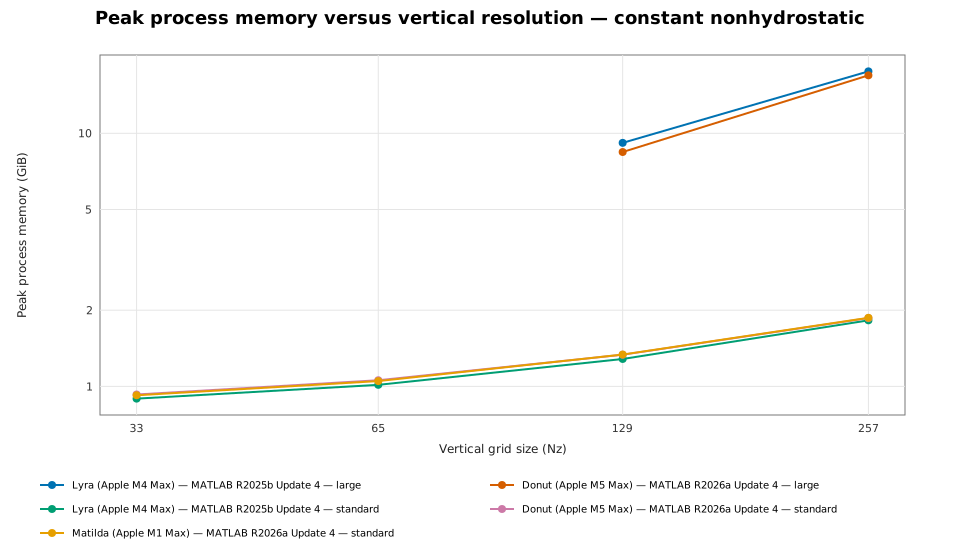
View all benchmark data
| Suite | Transform | Dataset | Resolution | Value | Status | Reason |
|---|---|---|---|---|---|---|
| scaling-large-v1 | Constant hydrostatic | Donut (Apple M5 Max) — WaveVortexModel MATLAB 4.2.1 (builtin; MATLAB 26.1.0.3312084 (R2026a) Update 4) — scaling-large-v1 | 129 | 8.79 GiB | complete | — |
| scaling-large-v1 | Constant hydrostatic | Lyra (Apple M4 Max) — WaveVortexModel MATLAB 4.2.1 (builtin; MATLAB 25.2.0.3150157 (R2025b) Update 4) — scaling-large-v1 | 129 | 8.74 GiB | complete | — |
| scaling-large-v1 | Constant hydrostatic | Matilda (Apple M1 Max) — WaveVortexModel MATLAB 4.2.1 (builtin; MATLAB 26.1.0.3312084 (R2026a) Update 4) — scaling-large-v1 | 129 | Unavailable | unavailable | No scaling-large-v1 dataset was collected for this environment. |
| scaling-large-v1 | Constant hydrostatic | Donut (Apple M5 Max) — WaveVortexModel MATLAB 4.2.1 (builtin; MATLAB 26.1.0.3312084 (R2026a) Update 4) — scaling-large-v1 | 257 | 14.9 GiB | complete | — |
| scaling-large-v1 | Constant hydrostatic | Lyra (Apple M4 Max) — WaveVortexModel MATLAB 4.2.1 (builtin; MATLAB 25.2.0.3150157 (R2025b) Update 4) — scaling-large-v1 | 257 | 16.7 GiB | complete | — |
| scaling-large-v1 | Constant hydrostatic | Matilda (Apple M1 Max) — WaveVortexModel MATLAB 4.2.1 (builtin; MATLAB 26.1.0.3312084 (R2026a) Update 4) — scaling-large-v1 | 257 | Unavailable | unavailable | No scaling-large-v1 dataset was collected for this environment. |
| scaling-large-v1 | Constant nonhydrostatic | Donut (Apple M5 Max) — WaveVortexModel MATLAB 4.2.1 (builtin; MATLAB 26.1.0.3312084 (R2026a) Update 4) — scaling-large-v1 | 129 | 8.43 GiB | complete | — |
| scaling-large-v1 | Constant nonhydrostatic | Lyra (Apple M4 Max) — WaveVortexModel MATLAB 4.2.1 (builtin; MATLAB 25.2.0.3150157 (R2025b) Update 4) — scaling-large-v1 | 129 | 9.17 GiB | complete | — |
| scaling-large-v1 | Constant nonhydrostatic | Matilda (Apple M1 Max) — WaveVortexModel MATLAB 4.2.1 (builtin; MATLAB 26.1.0.3312084 (R2026a) Update 4) — scaling-large-v1 | 129 | Unavailable | unavailable | No scaling-large-v1 dataset was collected for this environment. |
| scaling-large-v1 | Constant nonhydrostatic | Donut (Apple M5 Max) — WaveVortexModel MATLAB 4.2.1 (builtin; MATLAB 26.1.0.3312084 (R2026a) Update 4) — scaling-large-v1 | 257 | 16.9 GiB | complete | — |
| scaling-large-v1 | Constant nonhydrostatic | Lyra (Apple M4 Max) — WaveVortexModel MATLAB 4.2.1 (builtin; MATLAB 25.2.0.3150157 (R2025b) Update 4) — scaling-large-v1 | 257 | 17.6 GiB | complete | — |
| scaling-large-v1 | Constant nonhydrostatic | Matilda (Apple M1 Max) — WaveVortexModel MATLAB 4.2.1 (builtin; MATLAB 26.1.0.3312084 (R2026a) Update 4) — scaling-large-v1 | 257 | Unavailable | unavailable | No scaling-large-v1 dataset was collected for this environment. |
| scaling-large-v1 | Stratified QG | Donut (Apple M5 Max) — WaveVortexModel MATLAB 4.2.1 (builtin; MATLAB 26.1.0.3312084 (R2026a) Update 4) — scaling-large-v1 | 129 | 4.77 GiB | complete | — |
| scaling-large-v1 | Stratified QG | Lyra (Apple M4 Max) — WaveVortexModel MATLAB 4.2.1 (builtin; MATLAB 25.2.0.3150157 (R2025b) Update 4) — scaling-large-v1 | 129 | 4.73 GiB | complete | — |
| scaling-large-v1 | Stratified QG | Matilda (Apple M1 Max) — WaveVortexModel MATLAB 4.2.1 (builtin; MATLAB 26.1.0.3312084 (R2026a) Update 4) — scaling-large-v1 | 129 | Unavailable | unavailable | No scaling-large-v1 dataset was collected for this environment. |
| scaling-large-v1 | Stratified QG | Donut (Apple M5 Max) — WaveVortexModel MATLAB 4.2.1 (builtin; MATLAB 26.1.0.3312084 (R2026a) Update 4) — scaling-large-v1 | 257 | 8.73 GiB | complete | — |
| scaling-large-v1 | Stratified QG | Lyra (Apple M4 Max) — WaveVortexModel MATLAB 4.2.1 (builtin; MATLAB 25.2.0.3150157 (R2025b) Update 4) — scaling-large-v1 | 257 | 8.68 GiB | complete | — |
| scaling-large-v1 | Stratified QG | Matilda (Apple M1 Max) — WaveVortexModel MATLAB 4.2.1 (builtin; MATLAB 26.1.0.3312084 (R2026a) Update 4) — scaling-large-v1 | 257 | Unavailable | unavailable | No scaling-large-v1 dataset was collected for this environment. |
| scaling-large-v1 | Variable Boussinesq | Donut (Apple M5 Max) — WaveVortexModel MATLAB 4.2.1 (builtin; MATLAB 26.1.0.3312084 (R2026a) Update 4) — scaling-large-v1 | 129 | 10.6 GiB | complete | — |
| scaling-large-v1 | Variable Boussinesq | Lyra (Apple M4 Max) — WaveVortexModel MATLAB 4.2.1 (builtin; MATLAB 25.2.0.3150157 (R2025b) Update 4) — scaling-large-v1 | 129 | 12.3 GiB | complete | — |
| scaling-large-v1 | Variable Boussinesq | Matilda (Apple M1 Max) — WaveVortexModel MATLAB 4.2.1 (builtin; MATLAB 26.1.0.3312084 (R2026a) Update 4) — scaling-large-v1 | 129 | Unavailable | unavailable | No scaling-large-v1 dataset was collected for this environment. |
| scaling-large-v1 | Variable Boussinesq | Donut (Apple M5 Max) — WaveVortexModel MATLAB 4.2.1 (builtin; MATLAB 26.1.0.3312084 (R2026a) Update 4) — scaling-large-v1 | 257 | Unavailable | unavailable | Not collected on this 48 GiB host because the observed memory requirement left insufficient safety margin. |
| scaling-large-v1 | Variable Boussinesq | Lyra (Apple M4 Max) — WaveVortexModel MATLAB 4.2.1 (builtin; MATLAB 25.2.0.3150157 (R2025b) Update 4) — scaling-large-v1 | 257 | 30.7 GiB | complete | — |
| scaling-large-v1 | Variable Boussinesq | Matilda (Apple M1 Max) — WaveVortexModel MATLAB 4.2.1 (builtin; MATLAB 26.1.0.3312084 (R2026a) Update 4) — scaling-large-v1 | 257 | Unavailable | unavailable | No scaling-large-v1 dataset was collected for this environment. |
| scaling-large-v1 | Variable hydrostatic | Donut (Apple M5 Max) — WaveVortexModel MATLAB 4.2.1 (builtin; MATLAB 26.1.0.3312084 (R2026a) Update 4) — scaling-large-v1 | 129 | 8.52 GiB | complete | — |
| scaling-large-v1 | Variable hydrostatic | Lyra (Apple M4 Max) — WaveVortexModel MATLAB 4.2.1 (builtin; MATLAB 25.2.0.3150157 (R2025b) Update 4) — scaling-large-v1 | 129 | 8.46 GiB | complete | — |
| scaling-large-v1 | Variable hydrostatic | Matilda (Apple M1 Max) — WaveVortexModel MATLAB 4.2.1 (builtin; MATLAB 26.1.0.3312084 (R2026a) Update 4) — scaling-large-v1 | 129 | Unavailable | unavailable | No scaling-large-v1 dataset was collected for this environment. |
| scaling-large-v1 | Variable hydrostatic | Donut (Apple M5 Max) — WaveVortexModel MATLAB 4.2.1 (builtin; MATLAB 26.1.0.3312084 (R2026a) Update 4) — scaling-large-v1 | 257 | 14 GiB | complete | — |
| scaling-large-v1 | Variable hydrostatic | Lyra (Apple M4 Max) — WaveVortexModel MATLAB 4.2.1 (builtin; MATLAB 25.2.0.3150157 (R2025b) Update 4) — scaling-large-v1 | 257 | 16.2 GiB | complete | — |
| scaling-large-v1 | Variable hydrostatic | Matilda (Apple M1 Max) — WaveVortexModel MATLAB 4.2.1 (builtin; MATLAB 26.1.0.3312084 (R2026a) Update 4) — scaling-large-v1 | 257 | Unavailable | unavailable | No scaling-large-v1 dataset was collected for this environment. |
| scaling-standard-v1 | Constant hydrostatic | Donut (Apple M5 Max) — WaveVortexModel MATLAB 4.2.1 (builtin; MATLAB 26.1.0.3312084 (R2026a) Update 4) — scaling-standard-v1 | 129 | 1.31 GiB | complete | — |
| scaling-standard-v1 | Constant hydrostatic | Lyra (Apple M4 Max) — WaveVortexModel MATLAB 4.2.1 (builtin; MATLAB 25.2.0.3150157 (R2025b) Update 4) — scaling-standard-v1 | 129 | 1.26 GiB | complete | — |
| scaling-standard-v1 | Constant hydrostatic | Matilda (Apple M1 Max) — WaveVortexModel MATLAB 4.2.1 (builtin; MATLAB 26.1.0.3312084 (R2026a) Update 4) — scaling-standard-v1 | 129 | 1.31 GiB | complete | — |
| scaling-standard-v1 | Constant hydrostatic | Donut (Apple M5 Max) — WaveVortexModel MATLAB 4.2.1 (builtin; MATLAB 26.1.0.3312084 (R2026a) Update 4) — scaling-standard-v1 | 257 | 1.81 GiB | complete | — |
| scaling-standard-v1 | Constant hydrostatic | Lyra (Apple M4 Max) — WaveVortexModel MATLAB 4.2.1 (builtin; MATLAB 25.2.0.3150157 (R2025b) Update 4) — scaling-standard-v1 | 257 | 1.76 GiB | complete | — |
| scaling-standard-v1 | Constant hydrostatic | Matilda (Apple M1 Max) — WaveVortexModel MATLAB 4.2.1 (builtin; MATLAB 26.1.0.3312084 (R2026a) Update 4) — scaling-standard-v1 | 257 | 1.77 GiB | complete | — |
| scaling-standard-v1 | Constant hydrostatic | Donut (Apple M5 Max) — WaveVortexModel MATLAB 4.2.1 (builtin; MATLAB 26.1.0.3312084 (R2026a) Update 4) — scaling-standard-v1 | 33 | 0.927 GiB | complete | — |
| scaling-standard-v1 | Constant hydrostatic | Lyra (Apple M4 Max) — WaveVortexModel MATLAB 4.2.1 (builtin; MATLAB 25.2.0.3150157 (R2025b) Update 4) — scaling-standard-v1 | 33 | 0.88 GiB | complete | — |
| scaling-standard-v1 | Constant hydrostatic | Matilda (Apple M1 Max) — WaveVortexModel MATLAB 4.2.1 (builtin; MATLAB 26.1.0.3312084 (R2026a) Update 4) — scaling-standard-v1 | 33 | 0.92 GiB | complete | — |
| scaling-standard-v1 | Constant hydrostatic | Donut (Apple M5 Max) — WaveVortexModel MATLAB 4.2.1 (builtin; MATLAB 26.1.0.3312084 (R2026a) Update 4) — scaling-standard-v1 | 65 | 1.04 GiB | complete | — |
| scaling-standard-v1 | Constant hydrostatic | Lyra (Apple M4 Max) — WaveVortexModel MATLAB 4.2.1 (builtin; MATLAB 25.2.0.3150157 (R2025b) Update 4) — scaling-standard-v1 | 65 | 1.02 GiB | complete | — |
| scaling-standard-v1 | Constant hydrostatic | Matilda (Apple M1 Max) — WaveVortexModel MATLAB 4.2.1 (builtin; MATLAB 26.1.0.3312084 (R2026a) Update 4) — scaling-standard-v1 | 65 | 1.04 GiB | complete | — |
| scaling-standard-v1 | Constant nonhydrostatic | Donut (Apple M5 Max) — WaveVortexModel MATLAB 4.2.1 (builtin; MATLAB 26.1.0.3312084 (R2026a) Update 4) — scaling-standard-v1 | 129 | 1.33 GiB | complete | — |
| scaling-standard-v1 | Constant nonhydrostatic | Lyra (Apple M4 Max) — WaveVortexModel MATLAB 4.2.1 (builtin; MATLAB 25.2.0.3150157 (R2025b) Update 4) — scaling-standard-v1 | 129 | 1.28 GiB | complete | — |
| scaling-standard-v1 | Constant nonhydrostatic | Matilda (Apple M1 Max) — WaveVortexModel MATLAB 4.2.1 (builtin; MATLAB 26.1.0.3312084 (R2026a) Update 4) — scaling-standard-v1 | 129 | 1.34 GiB | complete | — |
| scaling-standard-v1 | Constant nonhydrostatic | Donut (Apple M5 Max) — WaveVortexModel MATLAB 4.2.1 (builtin; MATLAB 26.1.0.3312084 (R2026a) Update 4) — scaling-standard-v1 | 257 | 1.86 GiB | complete | — |
| scaling-standard-v1 | Constant nonhydrostatic | Lyra (Apple M4 Max) — WaveVortexModel MATLAB 4.2.1 (builtin; MATLAB 25.2.0.3150157 (R2025b) Update 4) — scaling-standard-v1 | 257 | 1.82 GiB | complete | — |
| scaling-standard-v1 | Constant nonhydrostatic | Matilda (Apple M1 Max) — WaveVortexModel MATLAB 4.2.1 (builtin; MATLAB 26.1.0.3312084 (R2026a) Update 4) — scaling-standard-v1 | 257 | 1.87 GiB | complete | — |
| scaling-standard-v1 | Constant nonhydrostatic | Donut (Apple M5 Max) — WaveVortexModel MATLAB 4.2.1 (builtin; MATLAB 26.1.0.3312084 (R2026a) Update 4) — scaling-standard-v1 | 33 | 0.929 GiB | complete | — |
| scaling-standard-v1 | Constant nonhydrostatic | Lyra (Apple M4 Max) — WaveVortexModel MATLAB 4.2.1 (builtin; MATLAB 25.2.0.3150157 (R2025b) Update 4) — scaling-standard-v1 | 33 | 0.895 GiB | complete | — |
| scaling-standard-v1 | Constant nonhydrostatic | Matilda (Apple M1 Max) — WaveVortexModel MATLAB 4.2.1 (builtin; MATLAB 26.1.0.3312084 (R2026a) Update 4) — scaling-standard-v1 | 33 | 0.923 GiB | complete | — |
| scaling-standard-v1 | Constant nonhydrostatic | Donut (Apple M5 Max) — WaveVortexModel MATLAB 4.2.1 (builtin; MATLAB 26.1.0.3312084 (R2026a) Update 4) — scaling-standard-v1 | 65 | 1.06 GiB | complete | — |
| scaling-standard-v1 | Constant nonhydrostatic | Lyra (Apple M4 Max) — WaveVortexModel MATLAB 4.2.1 (builtin; MATLAB 25.2.0.3150157 (R2025b) Update 4) — scaling-standard-v1 | 65 | 1.01 GiB | complete | — |
| scaling-standard-v1 | Constant nonhydrostatic | Matilda (Apple M1 Max) — WaveVortexModel MATLAB 4.2.1 (builtin; MATLAB 26.1.0.3312084 (R2026a) Update 4) — scaling-standard-v1 | 65 | 1.05 GiB | complete | — |
| scaling-standard-v1 | Stratified QG | Donut (Apple M5 Max) — WaveVortexModel MATLAB 4.2.1 (builtin; MATLAB 26.1.0.3312084 (R2026a) Update 4) — scaling-standard-v1 | 129 | 1.05 GiB | complete | — |
| scaling-standard-v1 | Stratified QG | Lyra (Apple M4 Max) — WaveVortexModel MATLAB 4.2.1 (builtin; MATLAB 25.2.0.3150157 (R2025b) Update 4) — scaling-standard-v1 | 129 | 0.996 GiB | complete | — |
| scaling-standard-v1 | Stratified QG | Matilda (Apple M1 Max) — WaveVortexModel MATLAB 4.2.1 (builtin; MATLAB 26.1.0.3312084 (R2026a) Update 4) — scaling-standard-v1 | 129 | 1.04 GiB | complete | — |
| scaling-standard-v1 | Stratified QG | Donut (Apple M5 Max) — WaveVortexModel MATLAB 4.2.1 (builtin; MATLAB 26.1.0.3312084 (R2026a) Update 4) — scaling-standard-v1 | 257 | 1.32 GiB | complete | — |
| scaling-standard-v1 | Stratified QG | Lyra (Apple M4 Max) — WaveVortexModel MATLAB 4.2.1 (builtin; MATLAB 25.2.0.3150157 (R2025b) Update 4) — scaling-standard-v1 | 257 | 1.27 GiB | complete | — |
| scaling-standard-v1 | Stratified QG | Matilda (Apple M1 Max) — WaveVortexModel MATLAB 4.2.1 (builtin; MATLAB 26.1.0.3312084 (R2026a) Update 4) — scaling-standard-v1 | 257 | 1.31 GiB | complete | — |
| scaling-standard-v1 | Stratified QG | Donut (Apple M5 Max) — WaveVortexModel MATLAB 4.2.1 (builtin; MATLAB 26.1.0.3312084 (R2026a) Update 4) — scaling-standard-v1 | 33 | 0.849 GiB | complete | — |
| scaling-standard-v1 | Stratified QG | Lyra (Apple M4 Max) — WaveVortexModel MATLAB 4.2.1 (builtin; MATLAB 25.2.0.3150157 (R2025b) Update 4) — scaling-standard-v1 | 33 | 0.806 GiB | complete | — |
| scaling-standard-v1 | Stratified QG | Matilda (Apple M1 Max) — WaveVortexModel MATLAB 4.2.1 (builtin; MATLAB 26.1.0.3312084 (R2026a) Update 4) — scaling-standard-v1 | 33 | 0.844 GiB | complete | — |
| scaling-standard-v1 | Stratified QG | Donut (Apple M5 Max) — WaveVortexModel MATLAB 4.2.1 (builtin; MATLAB 26.1.0.3312084 (R2026a) Update 4) — scaling-standard-v1 | 65 | 0.913 GiB | complete | — |
| scaling-standard-v1 | Stratified QG | Lyra (Apple M4 Max) — WaveVortexModel MATLAB 4.2.1 (builtin; MATLAB 25.2.0.3150157 (R2025b) Update 4) — scaling-standard-v1 | 65 | 0.871 GiB | complete | — |
| scaling-standard-v1 | Stratified QG | Matilda (Apple M1 Max) — WaveVortexModel MATLAB 4.2.1 (builtin; MATLAB 26.1.0.3312084 (R2026a) Update 4) — scaling-standard-v1 | 65 | 0.906 GiB | complete | — |
| scaling-standard-v1 | Variable Boussinesq | Donut (Apple M5 Max) — WaveVortexModel MATLAB 4.2.1 (builtin; MATLAB 26.1.0.3312084 (R2026a) Update 4) — scaling-standard-v1 | 129 | 1.63 GiB | complete | — |
| scaling-standard-v1 | Variable Boussinesq | Lyra (Apple M4 Max) — WaveVortexModel MATLAB 4.2.1 (builtin; MATLAB 25.2.0.3150157 (R2025b) Update 4) — scaling-standard-v1 | 129 | 1.59 GiB | complete | — |
| scaling-standard-v1 | Variable Boussinesq | Matilda (Apple M1 Max) — WaveVortexModel MATLAB 4.2.1 (builtin; MATLAB 26.1.0.3312084 (R2026a) Update 4) — scaling-standard-v1 | 129 | 1.6 GiB | complete | — |
| scaling-standard-v1 | Variable Boussinesq | Donut (Apple M5 Max) — WaveVortexModel MATLAB 4.2.1 (builtin; MATLAB 26.1.0.3312084 (R2026a) Update 4) — scaling-standard-v1 | 257 | 2.87 GiB | complete | — |
| scaling-standard-v1 | Variable Boussinesq | Lyra (Apple M4 Max) — WaveVortexModel MATLAB 4.2.1 (builtin; MATLAB 25.2.0.3150157 (R2025b) Update 4) — scaling-standard-v1 | 257 | 2.82 GiB | complete | — |
| scaling-standard-v1 | Variable Boussinesq | Matilda (Apple M1 Max) — WaveVortexModel MATLAB 4.2.1 (builtin; MATLAB 26.1.0.3312084 (R2026a) Update 4) — scaling-standard-v1 | 257 | 2.89 GiB | complete | — |
| scaling-standard-v1 | Variable Boussinesq | Donut (Apple M5 Max) — WaveVortexModel MATLAB 4.2.1 (builtin; MATLAB 26.1.0.3312084 (R2026a) Update 4) — scaling-standard-v1 | 33 | 0.987 GiB | complete | — |
| scaling-standard-v1 | Variable Boussinesq | Lyra (Apple M4 Max) — WaveVortexModel MATLAB 4.2.1 (builtin; MATLAB 25.2.0.3150157 (R2025b) Update 4) — scaling-standard-v1 | 33 | 0.952 GiB | complete | — |
| scaling-standard-v1 | Variable Boussinesq | Matilda (Apple M1 Max) — WaveVortexModel MATLAB 4.2.1 (builtin; MATLAB 26.1.0.3312084 (R2026a) Update 4) — scaling-standard-v1 | 33 | 0.995 GiB | complete | — |
| scaling-standard-v1 | Variable Boussinesq | Donut (Apple M5 Max) — WaveVortexModel MATLAB 4.2.1 (builtin; MATLAB 26.1.0.3312084 (R2026a) Update 4) — scaling-standard-v1 | 65 | 1.17 GiB | complete | — |
| scaling-standard-v1 | Variable Boussinesq | Lyra (Apple M4 Max) — WaveVortexModel MATLAB 4.2.1 (builtin; MATLAB 25.2.0.3150157 (R2025b) Update 4) — scaling-standard-v1 | 65 | 1.12 GiB | complete | — |
| scaling-standard-v1 | Variable Boussinesq | Matilda (Apple M1 Max) — WaveVortexModel MATLAB 4.2.1 (builtin; MATLAB 26.1.0.3312084 (R2026a) Update 4) — scaling-standard-v1 | 65 | 1.16 GiB | complete | — |
| scaling-standard-v1 | Variable hydrostatic | Donut (Apple M5 Max) — WaveVortexModel MATLAB 4.2.1 (builtin; MATLAB 26.1.0.3312084 (R2026a) Update 4) — scaling-standard-v1 | 129 | 1.33 GiB | complete | — |
| scaling-standard-v1 | Variable hydrostatic | Lyra (Apple M4 Max) — WaveVortexModel MATLAB 4.2.1 (builtin; MATLAB 25.2.0.3150157 (R2025b) Update 4) — scaling-standard-v1 | 129 | 1.27 GiB | complete | — |
| scaling-standard-v1 | Variable hydrostatic | Matilda (Apple M1 Max) — WaveVortexModel MATLAB 4.2.1 (builtin; MATLAB 26.1.0.3312084 (R2026a) Update 4) — scaling-standard-v1 | 129 | 1.31 GiB | complete | — |
| scaling-standard-v1 | Variable hydrostatic | Donut (Apple M5 Max) — WaveVortexModel MATLAB 4.2.1 (builtin; MATLAB 26.1.0.3312084 (R2026a) Update 4) — scaling-standard-v1 | 257 | 1.83 GiB | complete | — |
| scaling-standard-v1 | Variable hydrostatic | Lyra (Apple M4 Max) — WaveVortexModel MATLAB 4.2.1 (builtin; MATLAB 25.2.0.3150157 (R2025b) Update 4) — scaling-standard-v1 | 257 | 1.78 GiB | complete | — |
| scaling-standard-v1 | Variable hydrostatic | Matilda (Apple M1 Max) — WaveVortexModel MATLAB 4.2.1 (builtin; MATLAB 26.1.0.3312084 (R2026a) Update 4) — scaling-standard-v1 | 257 | 1.82 GiB | complete | — |
| scaling-standard-v1 | Variable hydrostatic | Donut (Apple M5 Max) — WaveVortexModel MATLAB 4.2.1 (builtin; MATLAB 26.1.0.3312084 (R2026a) Update 4) — scaling-standard-v1 | 33 | 0.947 GiB | complete | — |
| scaling-standard-v1 | Variable hydrostatic | Lyra (Apple M4 Max) — WaveVortexModel MATLAB 4.2.1 (builtin; MATLAB 25.2.0.3150157 (R2025b) Update 4) — scaling-standard-v1 | 33 | 0.907 GiB | complete | — |
| scaling-standard-v1 | Variable hydrostatic | Matilda (Apple M1 Max) — WaveVortexModel MATLAB 4.2.1 (builtin; MATLAB 26.1.0.3312084 (R2026a) Update 4) — scaling-standard-v1 | 33 | 0.938 GiB | complete | — |
| scaling-standard-v1 | Variable hydrostatic | Donut (Apple M5 Max) — WaveVortexModel MATLAB 4.2.1 (builtin; MATLAB 26.1.0.3312084 (R2026a) Update 4) — scaling-standard-v1 | 65 | 1.07 GiB | complete | — |
| scaling-standard-v1 | Variable hydrostatic | Lyra (Apple M4 Max) — WaveVortexModel MATLAB 4.2.1 (builtin; MATLAB 25.2.0.3150157 (R2025b) Update 4) — scaling-standard-v1 | 65 | 1.03 GiB | complete | — |
| scaling-standard-v1 | Variable hydrostatic | Matilda (Apple M1 Max) — WaveVortexModel MATLAB 4.2.1 (builtin; MATLAB 26.1.0.3312084 (R2026a) Update 4) — scaling-standard-v1 | 65 | 1.06 GiB | complete | — |
Integrator comparison
Setup. This historical comparison reuses the nonhydrostatic MATLAB-vs-C++ model, initial condition, 0.12 inertial-period duration, and 256 × 256 × 129 grid. Each table fixes the output workload, varies the integrator down the rows, and varies the execution path across the columns; the forcing and anti-aliasing remain fixed. Runtime and memory winners are identified independently within each execution-path column.
Conclusion. The highlighted cells identify the fastest runtime and lowest peak memory within each execution-path column of each workload table. These record-specific rankings compare integrators under one matched contract and should not be extrapolated to later source revisions or different workloads.
Coefficients only
| Integrator | MATLAB builtin | MATLAB + compiled core | Standalone C++ | |||
|---|---|---|---|---|---|---|
| Runtime | Peak memory | Runtime | Peak memory | Runtime | Peak memory | |
| Fixed RK4 | 53.27 s | 3.27 GiBLowest memory | 32.53 s | 3.84 GiBLowest memory | 31.93 s | 2.55 GiBLowest memory |
| ode23 / RK3(2) | 186.7 s | 3.62 GiB | 130.1 s | 4.13 GiB | 122.4 s | 2.64 GiB |
| ode45 / RK5(4) | 56.6 s | 4.07 GiB | 34.36 s | 4.46 GiB | 33.65 s | 2.77 GiB |
| ode78 / RK8(7) | 48.24 sFastest | 4.22 GiB | 28.55 sFastest | 4.59 GiB | 28.22 sFastest | 2.9 GiB |
Composite graph with dense output
| Integrator | MATLAB builtin | MATLAB + compiled core | Standalone C++ | |||
|---|---|---|---|---|---|---|
| Runtime | Peak memory | Runtime | Peak memory | Runtime | Peak memory | |
| Fixed RK4 | 64.37 s | 4.18 GiBLowest memory | 51.75 s | 5.3 GiBLowest memory | 41.65 s | 3.08 GiBLowest memory |
| ode23 / RK3(2) | 253.2 s | 6.39 GiB | 231.1 s | 6.83 GiB | 170.7 s | 3.19 GiB |
| ode45 / RK5(4) | 75.83 s | 9.1 GiB | 63.34 s | 9.68 GiB | 45.15 s | 3.41 GiB |
| ode78 / RK8(7) | 63.42 sFastest | 10.4 GiB | 51.67 sFastest | 10.8 GiB | 38.35 sFastest | 4.01 GiB |
Benchmark conditions, environments, and downloads
The generated interface summary identifies the selected compatible record and its source, platform, provider, and sample count. Comparisons require matching suite contracts, operations, domains, resolutions, numerical options, random seeds, warmup counts, and sample counts. Results from different environments reflect both hardware and toolchain differences.
The normalized public downloads below remain available. The original M5 raw archives for August 27–28 were unavailable in the local artifact repository during the September 12 audit; their recorded hashes and expected paths are preserved in the benchmark audit.
Benchmark tools are authoring utilities and are not installed on the runtime package path. The benchmark authoring guide documents suite definitions, measurement boundaries, correctness gates, provenance, and publication. Missing coverage is reported as unavailable, never as zero or extrapolated performance.
Test environments
| Implementation | Platform | Processor | Physical memory | OS / architecture | Toolchain | Threads |
|---|---|---|---|---|---|---|
| WaveVortexModel MATLAB unreleased-preview (builtin) | Donut (Apple M5 Max) | Apple M5 Max | 48 GiB | Darwin 25.5.0 Darwin Kernel Version 25.5.0: Tue Jun 9 22:28:34 PDT 2026; root:xnu-12377.121.10~1/RELEASE_ARM64_T6050 arm64 / maca64 | MATLAB 26.1.0.3312084 (R2026a) Update 4 | 18 |
| WaveVortexModel compiled preview unreleased-preview (native-fftw) | Donut (Apple M5 Max) | Apple M5 Max | 48 GiB | Darwin 25.5.0 Darwin Kernel Version 25.5.0: Tue Jun 9 22:28:34 PDT 2026; root:xnu-12377.121.10~1/RELEASE_ARM64_T6050 arm64 / maca64 | Apple Clang + FFTW 21.0.0 | 18 |
| WaveVortexModel MATLAB 4.2.1 (builtin) | Lyra (Apple M4 Max) | Apple M4 Max | 128 GiB | Darwin 25.5.0 Darwin Kernel Version 25.5.0: Tue Jun 9 22:28:34 PDT 2026; root:xnu-12377.121.10~1/RELEASE_ARM64_T6041 arm64 / maca64 | MATLAB 25.2.0.3150157 (R2025b) Update 4 | 16 |
| WaveVortexModel MATLAB 4.2.1 (builtin) | Matilda (Apple M1 Max) | Apple M1 Max | 64 GiB | Darwin 25.5.0 Darwin Kernel Version 25.5.0: Tue Jun 9 22:18:58 PDT 2026; root:xnu-12377.121.10~1/RELEASE_ARM64_T6000 arm64 / maca64 | MATLAB 26.1.0.3312084 (R2026a) Update 4 | 10 |
Downloadable results
The compact published JSON records contain the measurements and correctness evidence used by this page. Raw worker outputs and RSS samples remain outside the source tree.
| Dataset | Implementation | Platform | Suite | Collected | Schema | Normalized | Raw artifact |
|---|---|---|---|---|---|---|---|
| core-v1--cpp-native-fftw--m5-max--20260812T195257Z | WaveVortexModel compiled preview unreleased-preview | Donut (Apple M5 Max) | core-v1 | 2026-08-12T19:52:57Z | published-benchmark-v1 | Published JSON | Raw JSON |
| core-v1--matlab-builtin--m5-max--20260812T195257Z | WaveVortexModel MATLAB unreleased-preview | Donut (Apple M5 Max) | core-v1 | 2026-08-12T19:52:57Z | published-benchmark-v1 | Published JSON | Raw JSON |
| scaling-large-v1--matlab-builtin--lyra--20260811T213524Z | WaveVortexModel MATLAB 4.2.1 | Lyra (Apple M4 Max) | scaling-large-v1 | 2026-08-11T21:35:24Z | published-benchmark-v1 | Published JSON | Raw JSON |
| scaling-large-v1--matlab-builtin--m5-max--20260812T023122Z | WaveVortexModel MATLAB 4.2.1 | Donut (Apple M5 Max) | scaling-large-v1 | 2026-08-12T02:31:22Z | published-benchmark-v1 | Published JSON | Raw JSON |
| scaling-standard-v1--matlab-builtin--lyra--20260811T204835Z | WaveVortexModel MATLAB 4.2.1 | Lyra (Apple M4 Max) | scaling-standard-v1 | 2026-08-11T20:48:35Z | published-benchmark-v1 | Published JSON | Raw JSON |
| scaling-standard-v1--matlab-builtin--m5-max--20260812T020708Z | WaveVortexModel MATLAB 4.2.1 | Donut (Apple M5 Max) | scaling-standard-v1 | 2026-08-12T02:07:08Z | published-benchmark-v1 | Published JSON | Raw JSON |
| scaling-standard-v1--matlab-builtin--matilda--20260811T205115Z | WaveVortexModel MATLAB 4.2.1 | Matilda (Apple M1 Max) | scaling-standard-v1 | 2026-08-11T20:51:15Z | published-benchmark-v1 | Published JSON | Raw JSON |
| three-interface--boussinesq-exponential--m4-max--20260913T140607Z | MATLAB builtin / MATLAB compiled / standalone compiled | Apple M4 Max | three-interface | 2026-09-13T14:06:07Z | published-three-interface-v4 | Published JSON | External archive: 1e91d3d7be10… |
| three-interface--boussinesq-exponential--m4-max--20260913T235744Z | MATLAB builtin / MATLAB compiled / standalone compiled | Apple M4 Max | three-interface | 2026-09-13T23:57:44Z | published-three-interface-v4 | Published JSON | External archive: 6ccb3645c633… |
| three-interface--constant-nonhydrostatic--m4-max--20260913T133115Z | MATLAB builtin / MATLAB compiled / standalone compiled | Apple M4 Max | three-interface | 2026-09-13T13:31:15Z | published-three-interface-v4 | Published JSON | External archive: 2ef32106c44a… |
| three-interface--constant-nonhydrostatic--m4-max--20260914T002703Z | MATLAB builtin / MATLAB compiled / standalone compiled | Apple M4 Max | three-interface | 2026-09-14T00:27:03Z | published-three-interface-v4 | Published JSON | External archive: d63eda0dc56f… |
| three-interface--hydrostatic-exponential--m4-max--20260913T134854Z | MATLAB builtin / MATLAB compiled / standalone compiled | Apple M4 Max | three-interface | 2026-09-13T13:48:54Z | published-three-interface-v4 | Published JSON | External archive: 43bec9ecaf0f… |
| three-interface--hydrostatic-exponential--m4-max--20260913T234347Z | MATLAB builtin / MATLAB compiled / standalone compiled | Apple M4 Max | three-interface | 2026-09-13T23:43:47Z | published-three-interface-v4 | Published JSON | External archive: 9c6625d6ba6f… |
| three-interface--lyra--20260816T034908Z | MATLAB builtin / MATLAB compiled / standalone compiled | Lyra (Apple M4 Max) | three-interface | 2026-08-16T03:49:08Z | published-three-interface-v2 | Published JSON | External archives: e2f05927488d…, e8f480484b36… |
| three-interface--lyra--20260816T044250Z | MATLAB builtin / MATLAB compiled / standalone compiled | Lyra (Apple M4 Max) | three-interface | 2026-08-16T04:42:50Z | published-three-interface-v2 | Published JSON | External archives: 3e83bcca157c…, c3be332c475b… |
| three-interface--m5-max--20260827T151230Z | MATLAB builtin / MATLAB compiled / standalone compiled | Apple M5 Max | three-interface | 2026-08-27T15:12:30Z | published-three-interface-v3 | Published JSON | External archive: 68714c20e30a… |
| three-interface--m5-max--20260828T143049Z | MATLAB builtin / MATLAB compiled / standalone compiled | Apple M5 Max | three-interface | 2026-08-28T14:30:49Z | published-three-interface-v3 | Published JSON | External archive: 54f3d6d104ec… |